Blogerroom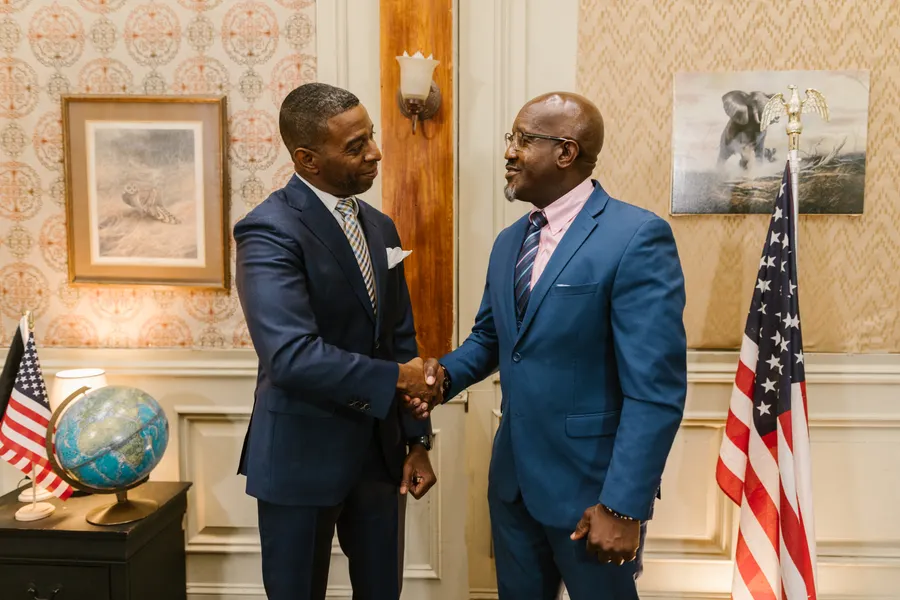
Trump and Xi Agree on AI: Neither Wants to Regulate It
The Trump-Xi summit discussed AI for three days and produced no deal — only a shared preference to let the AI race run without oversight.
Three days of summitry, a state dinner in the East Room, a bald eagle sculpture presented as a gift, a tour of the National Archives, tea at the White House, and a Marine One departure from a freshly poured granite landing pad. When Chinese President Xi Jinping's plane lifted off for Beijing on Friday, September 25, 2026, the most specific thing President Trump told reporters about their AI conversations was that American farmers were going to be very happy.
That absence of specificity is the actual finding. According to reporting from CBS News, CNN, and the Eastern Herald, the two leaders discussed artificial intelligence extensively across their three days in Washington, and wrapped the summit having reached exactly one conclusion: neither government wants anyone telling their AI companies what to do.
What the Summit Was Supposed to Deliver
The September 24 meeting had come loaded with expectations from the AI safety community. Dario Amodei's essay calling for deliberate AI pacing, backed by Sam Altman and Elon Musk, had explicitly named international coordination between democracies as its third and most ambitious step. The UN Security Council's September 23 session on AI — which saw OpenAI and DeepSeek share a podium for the first time — had framed the summit as a historic opportunity. Advocates from think tanks including the Peterson Institute for International Economics had privately hoped the visit might produce at least a working framework for a bilateral dialogue.
What emerged instead was closer to what PIIE researchers predicted: limited progress, intense rivalry, and continued inertia. No joint statement was signed. No framework for AI governance was announced. A proposed emergency channel for reporting AI-related security incidents, which US Treasury officials had floated in pre-summit discussions, remains under negotiation rather than finalized. The chip export dispute, a central friction point between the two governments on AI capability, stayed unresolved.

The Dinner That Told a Different Story
The most revealing image of the summit may not have been any official document. Sam Altman, CEO of OpenAI, and Mark Zuckerberg, CEO of Meta, were both photographed at the East Room state dinner, seated among Xi's official guests. No equivalent Chinese AI executives were present in the American press pool's shots.
That configuration captures the summit's underlying dynamic: AI was nominally on the diplomatic agenda as a shared challenge, but practically on the table as a competitive arena where both sides were measuring each other's strength rather than negotiating mutual restraint. Having the CEOs of America's two most prominent AI labs seated at the dinner for the leader of America's primary AI rival is a statement about who holds the assets, not about who is ready to limit them.
Where the Two Governments Genuinely Agreed
On the actual substance of AI governance, the summit's clearest output is what both sides explicitly rejected. China had already dismissed the industry's AI slowdown calls as fearmongering just two weeks earlier, calling the proposals a Cold War playbook targeting Chinese development. Trump had separately attacked Amodei by name and declared that the only AI guardrail the country needs is a strong and smart president. Both governments, from opposite political traditions and for opposite stated reasons, landed in the same place: the AI race should run without binding international oversight, and whoever builds faster wins.
That rare point of agreement between Washington and Beijing was, in a narrow sense, the summit's most durable finding on AI. The Eastern Herald's analysis described it plainly: Trump and Xi agreed on exactly one thing, and that one thing was that neither wants anyone telling their AI companies what to do.
What Xi Promised Instead
Xi's most concrete summit deliverables were cultural and educational rather than technological. He announced that China will send two giant pandas to Zoo Atlanta, continuing a decades-old diplomatic tradition. He offered study invitations to 100,000 American students to visit China. And he noted that the two leaders were likely to see each other again at the APEC summit in Shenzhen, where China is hosting in December, and at the G20 in Miami, also in December.
The APEC reference matters beyond its diplomatic courtesy. China is hosting APEC in 2026, and Xi has already signaled that AI will be a central agenda item for that gathering. The APEC AI Initiative adopted in 2025 focuses primarily on accelerating AI development with secondary references to safety, a structure that reflects the same underlying preference for speed over oversight that drove the Washington summit to its non-result.
The Chips Fight That Never Got Resolved
Sitting behind the diplomatic language about continued dialogue is a much harder dispute that three days of summitry didn't touch. US export controls on advanced AI chips, specifically restrictions on selling Nvidia's most capable processors to Chinese buyers, remain in place and remain the single largest practical constraint on China's ability to train frontier AI models at scale. Xi's government has consistently framed those restrictions as a technological blockade rather than a legitimate security measure. Trump's administration has defended them as a tool for maintaining American AI advantage.
Neither side was willing to move on that fundamental disagreement, and without movement there, any AI governance discussion between Washington and Beijing operates on top of an unresolved foundation. You can't meaningfully negotiate shared AI safety standards with a country whose primary AI hardware procurement is subject to your own export restrictions, and neither government showed any sign of treating that contradiction as something they were ready to resolve.
A Summit That Changed the Framing, Not the Facts
What the Trump-Xi summit actually changed is subtler than any headline agreement or announced framework. Two weeks ago, AI safety advocates could plausibly argue that the summit represented a genuine diplomatic opening, a moment when two leaders who had both implicitly rejected the slowdown call might find common ground on narrower, less politically charged questions like incident reporting or safety research transparency. That argument is now harder to make. The summit happened, AI was discussed at length, and the outcome was two governments confirming they prefer the current arrangement, an unregulated race with the winner determined by chips, power, and open-source models, rather than anything they'd be willing to constrain together.
The next formal opportunity is December in Shenzhen. Whether anything changes between now and then depends less on what the two presidents said in Washington and more on what happens in the AI labs, the chip fabs, and the data centers that neither summit was designed to govern.
Written by
Mr. Aayush Bhatt
Software Engineer with in depth understanding of buliding softwares and Tech.