Blogerroom
Joburg Poll: Zille Leads, but the DA Is Stuck at 29%
A News24/SABI poll has Zille at 36% but the DA at 29% in Johannesburg; she says she will take the DA into opposition rather than run a nine-party coalition.
Helen Zille is more popular than her own party. A News24/SABI poll published this week puts the Democratic Alliance's mayoral candidate at 36 percent in Johannesburg, while the DA itself sits at 29 percent, according to the explainer site explain.co.za. In South Africa, voters do not choose mayors directly, so that seven-point gap is a lead that cannot be cashed in at the ballot box. The metro votes on November 4, and the maths already points to a deal nobody has agreed to.
A candidate ahead of her party
The News24 poll surveyed 5,001 registered voters in the city. It shows the ANC falling 10 points to 23 percent, which puts the DA ahead. But even allowing for swing voters, the poll puts the DA's ceiling at roughly 40 percent, well short of a majority, explain.co.za reported.
Other surveys tell a similar story of fragmentation, with different numbers. An Ipsos poll published in September put the ANC at 31 percent in Johannesburg and the DA at 27 percent, according to Daily Maverick. The two polls are not directly comparable. Ipsos interviewed a broader sample of South Africans, while News24/SABI focused on registered metro voters. Neither points to an easy majority, and that is the finding that matters.

Who can the DA actually work with?
The DA will not govern with the EFF or MK, and its relationship with ActionSA, led by former DA mayor Herman Mashaba, is famously rocky, explain.co.za noted. Remove those three and the arithmetic leaves one large party: the ANC.
That is not an easy marriage either. At national level the two parties already share the Government of National Unity formed after the ANC fell to 40.2 percent in the 2024 election, according to the Friedrich Naumann Foundation. In Gauteng, though, the ANC's leaders have been much cooler about the DA than their national counterparts, and until recently all three Gauteng metros were run by combinations involving the ANC, EFF and ActionSA. The poll offers a nudge. Voters rated the national unity government more favourably than either party on its own.
So the incentive structure is odd. Voters seem to like the idea of the two big parties cooperating more than they like the parties, while the local branches that would have to do the cooperating are the least keen.
Zille's opposition threat
On October 12, Daily Maverick reported that Zille will take the DA into opposition rather than govern through a coalition she considers unworkable. With 82 parties and independents contesting Johannesburg, she said she is not interested in a nine-party arrangement because someone will always pull in a different direction.
Read that as both a principle and a bargaining position. Threatening to walk away makes the DA's terms harder to refuse, since the alternative for smaller parties is another unstable coalition under someone else. It also carries a risk. A city that has seen ten mayors in nine years, per explain.co.za, will not necessarily reward a party that declines to run it.
Why the city keeps breaking
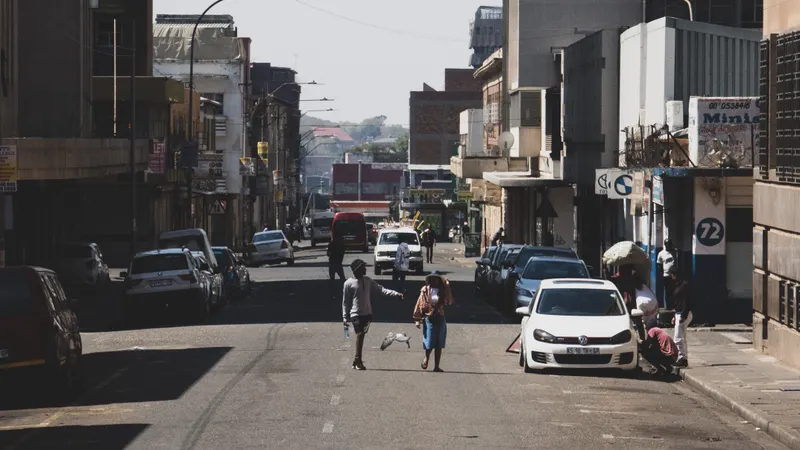
Johannesburg's instability is a feature of the rules, not just of the personalities. South Africa had 66 hung councils after the 2021 local elections, more than double the number in 2016, explain.co.za reported. Since then, residents have lived with shifting alliances, repeated no-confidence votes and a revolving door of mayors.
The government's answer is a coalitions bill that would require written agreements, add protection against constant mayoral removals and encourage executive committees whose seats reflect election results. The bill was drafted as the Local Government: Municipal Structures Amendment Bill, and it has stalled in Parliament. The Friedrich Naumann Foundation had already predicted it would not pass before November. Voters are heading into another election under the rules that produced the last cycle.
Fragmented outcomes are not unique to South Africa. In Quebec, the Parti Québécois won on about 28 percent of the vote and needs allies to act, and in Germany, a handful of BSW seats gave the AfD the speaker's chair in Saxony-Anhalt. The pattern is the same: when no one wins outright, the smallest party in the room sets the price.
What it means for the nation
Local councils may seem like a lower-stakes contest, but the polls suggest the national picture is shifting. An Ipsos survey from early September had the ANC at 31 percent nationally, the DA at 25, MK at 14 and the EFF at 11, according to Daily Maverick. In eThekwini, which includes Durban, MK polled 55 percent among voters who named a party. If the ANC drops sharply on November 4, its leadership contest in December 2027 will open under pressure, one analysis by the Friedrich Naumann Foundation argued.
The test on election night is not who comes first in Johannesburg. It is whether the national unity partners can turn the same pact into a working majority in the country's largest city. If they cannot, the likeliest result is a council that again has no clear leader, at a time when voters are watching Zille's poll numbers and her party's numbers diverge.
---
Written by
Dr. Anand Sharma
Deep Understanding of domestic and international policy.