Blogerroom

Climate Tipping Points Get Studied Unevenly, PNAS Finds
A PNAS review of 20,736 papers finds Greenland gets 20% of tipping-point research while boreal permafrost, with a similar 1.5C threshold, gets 0.7%.
Scientists have a list of parts of the climate system that could change abruptly if warming pushes them past a threshold, from ice sheets and the Amazon to coral reefs and ocean currents. A study published this month in the Proceedings of the National Academy of Sciences asks a different question: does the amount of research on each of those systems match how close each one may be to tipping? The answer, according to the authors, is no.
The team, which includes Asaf Tzachor of the University of Cambridge's Centre for the Study of Existential Risks, who wrote a summary of the paper, analyzed 20,736 publications on 14 tipping elements published between 2000 and 2025.
What the Team Counted
The idea behind the study is simple. The authors tallied how many papers addressed each tipping element and compared the totals with published estimates of the level of global warming at which each might tip. If researchers were prioritizing the most vulnerable systems, systems with lower thresholds should attract more attention.
They also looked at what the papers covered. Beyond whether a study discussed a system, the team checked whether it gave explicit attention to the features that make a tipping point different from gradual change: abruptness, self-reinforcement, persistence and irreversibility.
Where the Attention Went
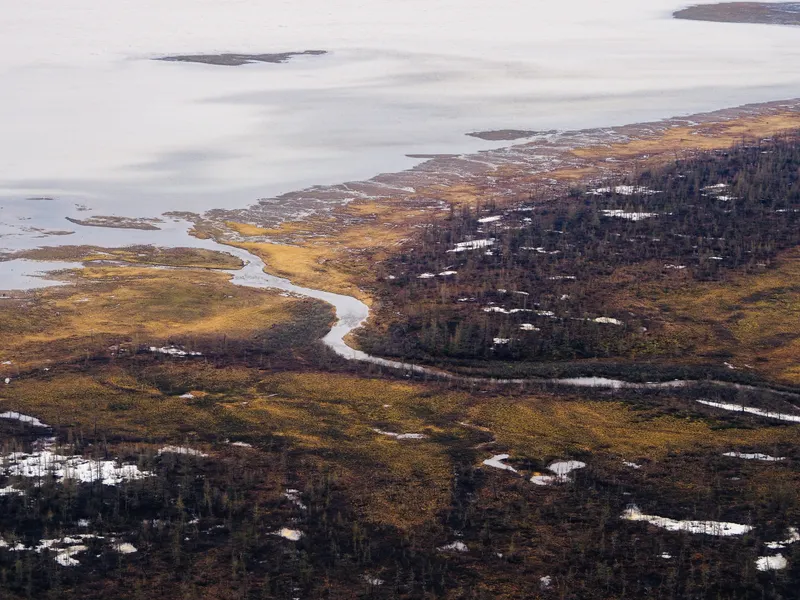
Research is heavily concentrated. The Greenland Ice Sheet appeared in 4,141 publications, 20% of the entire dataset, Tzachor reports. By contrast, abrupt thaw of permafrost in boreal forests, just below the Arctic, appeared in 139 papers, or 0.7%. The North Atlantic subpolar gyre, a ring of ocean circulation south of Greenland, accounted for 649 papers, or 3.1%. Barents Sea winter ice and the East Antarctic subglacial basins also received comparatively little.
Unequal numbers on their own are not surprising. Some systems have been observed longer, are easier to measure or model, or sit within larger, better-established fields.
Thresholds Did Not Predict Attention
The more telling comparison involves warming. Boreal permafrost thaw has a best-estimate threshold of about 1.5°C above preindustrial temperatures, Tzachor writes. The estimate for the subpolar gyre is around 1.8°C. Greenland's is also around 1.5°C. Yet the team found no systematic tendency for systems presumed to tip earlier to attract more research. Some with similarly low thresholds receive thousands of studies, and others hundreds or fewer.
That is the central result: attention follows research traditions, funding and tools, not obvious risk.
What Was Studied About Each System
The content of the papers adds a second gap. Only 8.1% of the publications examined one or more of the risk-relevant characteristics of tipping points explicitly. For some systems the shortfall is stark. Across 26 years, the team found as few as 22 peer-reviewed studies examining such dynamics in abrupt boreal permafrost thaw and low-latitude coral reefs, and 53 for the subpolar gyre, according to the authors.
In practice, that means researchers know a great deal about how much ice Greenland is losing and much less about whether, for several other systems, a change could accelerate, sustain itself or fail to reverse.
Reading the Result Carefully
The authors are careful about what their analysis shows. A warming threshold is not a countdown timer, Tzachor writes, and estimates come with substantial uncertainty. The number of papers says nothing about how strong the evidence for a particular tipping point is, or about the quality or importance of individual studies. The study measures scientific attention, not scientific certainty.
There are overlaps too. The subpolar gyre is closely connected to the Atlantic Meridional Overturning Circulation, so relevant work may sit inside much larger studies of that current without treating the gyre as a separate element. And the authors do not argue that Greenland researchers should shift focus. There are good reasons why some fields build large research communities.
I have read the published summary of the paper rather than the full PNAS article, so exact counts for the other tipping elements should be checked there.
What It Suggests
The practical message is about gaps. For systems with low estimated thresholds but little research, more studies could clarify what is known, what remains uncertain, and which uncertainties matter most, the authors suggest. Monitoring capacity and funding decisions shape what gets studied, and those are choices made collectively.
The Arctic offers an example of why measurement matters. Blogerroom reported a NASA finding that the Arctic melt season stopped getting longer around 2010, a change scientists could not fully explain. A different case concerns the Amazon rainforest, which Blogerroom covered in its look at why protecting standing forest beats replanting trees. The Amazon is one of the systems the tipping literature tracks.
My view: the strongest takeaway is the question Tzachor poses to decision-makers. Which consequential climate risks are hard to assess because little science has reached them? Finding those gaps before the climate system tests them is cheaper than discovering them afterward.
Written by
Mr. Jitendra Bhatt
Msc in Chemistry and field researcher.