Blogerroom
Arctic Melt Season Growth Mysteriously Stalled After 2010
NASA finds the Arctic melt season grew 40 days longer since 1979, then plateaued around 2010 despite continued warming.
For three decades, the Arctic Ocean's melt season kept doing the same troubling thing: starting earlier, ending later, and stretching further into the calendar with each passing year. Then, around 2010, it simply stopped. Not the melting itself, and not the underlying warming driving it, just the decades-long trend of the season getting steadily longer.
A NASA-led study published in Communications Earth & Environment and highlighted by the agency's Earth Observatory this September documents that plateau in detail, using satellite observations spanning 1979 through 2023. The Arctic melt season is now roughly 40 days longer than it was at the start of that record. Almost all of that increase happened before 2010. Since then, the average length has held remarkably steady, even as individual years swing dramatically in either direction.
What actually changed, and when
Researchers tracked two specific dates each year across the Arctic Ocean: when sea ice starts melting in spring, and when it refreezes in autumn. The lengthening melt season, it turns out, was driven overwhelmingly by one of those two shifts. Freeze-up began occurring later in the year, responsible for roughly 34 of the 40 added days, while earlier spring melting contributed a comparatively modest seven days, according to the study's findings as reported by NASA Earth Observatory.
That imbalance points to where the real story lives: in what happens to Arctic ice during the darkest, coldest months, not the bright summer melt everyone pictures when they think about vanishing polar ice. The 2000s saw the fastest changes, with some regions seeing the melt season lengthen by as much as five days annually during that decade, according to NASA's mapped data.

Why darker water changed everything, until it didn't
The mechanism behind the pre-2010 acceleration is well understood in climate science, even if its abrupt pause wasn't predicted. As sea ice retreated earlier and covered less area each summer, it exposed larger stretches of open, dark ocean water. Dark water absorbs far more solar energy than reflective white ice does, and that extra absorbed heat delayed the autumn freeze, according to NASA's explanation of the process. More open water meant more heat, which meant later freezing, which meant an even longer melt season the following year, a feedback loop that should, in theory, keep compounding.
Instead, since 2010, that compounding effect appears to have run into a counteracting force. Changing cloud patterns across parts of the Arctic Ocean have reduced how much sunlight actually reaches the water's surface, according to the study, effectively throttling back the solar-heating feedback loop that had been driving the trend for the previous three decades.
A plateau built on much thinner ice
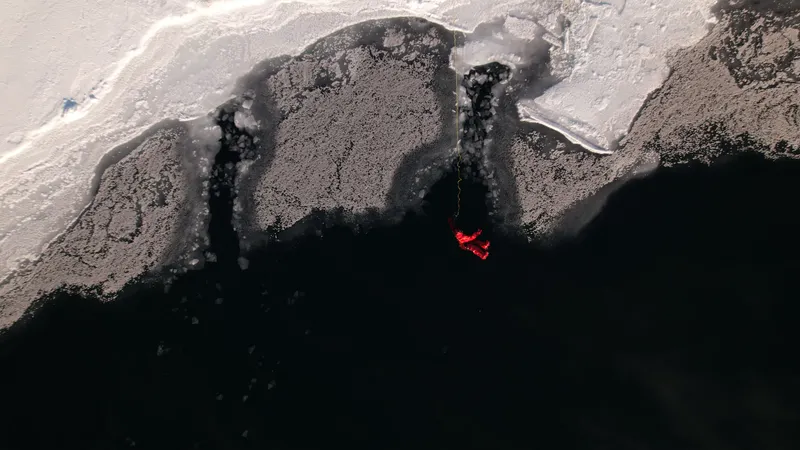
Here's the part of the finding that complicates any reading of this as good news: the ice sitting beneath that stabilized melt season is fundamentally different, and more fragile, than what was there in 1979. Linette Boisvert, a co-author on the study and ice scientist at NASA's Goddard Space Flight Center, explained the shift plainly. "Previously, there was more of this multiyear ice that didn't melt away each summer," she said, according to NASA's Earth Observatory. "Now that the ice is thinner and there's less of it, there's a lot more variability."
That distinction matters enormously for how to interpret a flat trend line. Multiyear ice, thick enough to survive multiple summers without fully melting, acts as a buffer against short-term weather swings. Thinner, younger seasonal ice doesn't have that resilience, which is precisely why the post-2010 period shows an average melt season length holding steady at around 108 days while swinging by roughly 11 days in either direction from one year to the next, according to the study published in Communications Earth & Environment. A stable average sitting on top of that much year-to-year volatility is a very different kind of stability than a genuinely settled climate system.
What this means for reading climate data more carefully
This finding offers a useful, if uncomfortable, lesson about interpreting environmental trend data. A flattening line on a graph doesn't automatically mean a problem has resolved itself; sometimes it means the underlying system has become more chaotic in ways that happen to average out over a longer stretch of years. The Arctic's melt season plateau isn't evidence that warming has stopped affecting the region. It's evidence that a second climate mechanism, shifting cloud cover, has temporarily offset one specific consequence of that warming, while the ice itself keeps getting thinner and more vulnerable underneath.
That kind of nuance echoes a broader pattern researchers keep encountering as they dig deeper into ocean and climate systems: a recent study using 400 years of coral and tree-ring records found that human-caused warming is now actively breaking a long-standing climate link between the Indian and Pacific oceans, a reminder that climate systems built on multi-century patterns can shift in ways that don't always show up as a simple, steadily worsening line on a chart.
The stabilization researchers say could still be temporary
The study's authors were explicit that this plateau shouldn't be read as a sign the Arctic has stabilized more broadly. Thick, multiyear ice still persists year-round in specific regions, particularly north of Greenland and across the Canadian Arctic Archipelago. Continued thinning in those specific holdout areas, the researchers warned, could trigger a fresh period of rapid sea ice loss and push the melt season into another extended stretch, according to NASA's coverage of the findings.
That caveat matters because it identifies exactly where to watch next. The current stability isn't a broad, Arctic-wide phenomenon protecting all remaining ice equally; it's concentrated on a shrinking pool of the thickest, oldest ice that's held on so far. If that specific reserve keeps eroding the way the rest of the Arctic's ice cover already has, the mechanism currently holding the melt season steady could simply run out of ice thick enough to buffer against it.
Why this particular record matters going forward
Satellite monitoring of Arctic sea ice has now run long enough, 44 years and counting, to reveal patterns that shorter records simply couldn't have caught: not just a straightforward warming trend, but genuine inflection points where competing physical processes trade off against each other in ways scientists are still working to fully explain. The 2010 plateau is exactly that kind of inflection point, and its causes, the interplay between shrinking multiyear ice, shifting cloud patterns, and the Arctic's overall energy balance, remain an active area of research.
What's clear already is that a flat melt-season trend line since 2010 hasn't meant a flat Arctic. It's meant an Arctic running on a thinner, less stable ice pack that happens, for now, to be producing a deceptively steady average. Whether that holds through the next decade likely depends on what happens to the ice still surviving north of Greenland, ice that's had nowhere left to retreat to for years.
Written by
Mr. Jitendra Bhatt
Msc in Chemistry and field researcher.