Blogerroom
Birds Now Migrate 14 Days Earlier; Only Spring Gains Help
A 549-species analysis in Nature Ecology & Evolution finds migration advanced 13.86 days since 1970, but earlier autumn departures linked to declines.
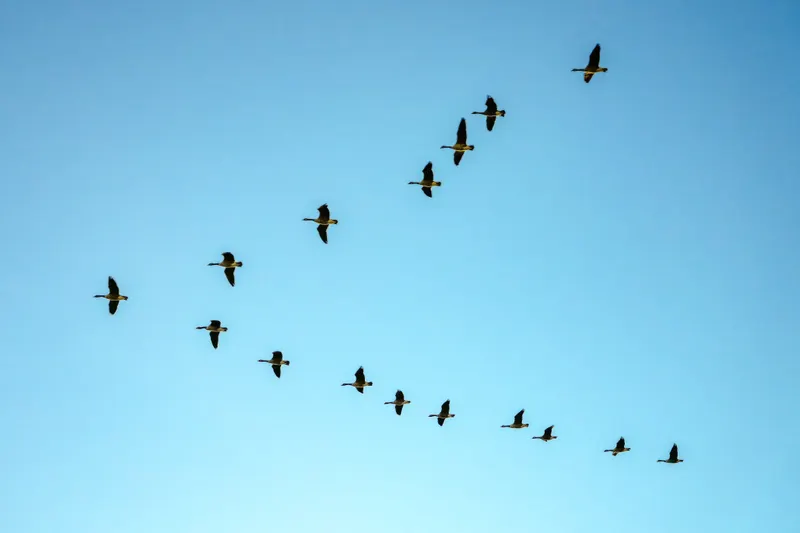
For years, the standard good-news line about climate change and migratory birds has been that they are adapting. They leave earlier, arrive earlier and track the shifting spring. A study published in Nature Ecology & Evolution this week asks whether that adaptation actually pays off for the birds, and the answer depends on the season.
The team, led by Jin Liu and Shaopeng Wang at Peking University, with colleagues including Richard Fuller at the University of Queensland and Thomas Mueller, assembled what a summary of the paper calls one of the largest datasets on avian migration timing yet compiled. Its headline number is 13.86 days: the cumulative advance in migration timing between 1970 and 2019.
What the Team Compiled
The database holds 4,351 population-level estimates of migration timing covering 549 bird species around the world, according to the summary. Each estimate was matched with population trend data and with the pace of climate change at both the breeding and non-breeding grounds of that population. That pairing is what lets the study ask a question earlier work could not answer at global scale: do the shifts help or harm?
The authors used Bayesian models that account for evolutionary relatedness, since closely related species tend to behave alike. Population trends were measured in two ways, with categories from the IUCN Red List and with continuous rates of change drawn from time-series databases including the Living Planet Index, BioTIME and TetraDENSITY. They then added a theoretical model that follows a population through its full annual cycle: spring migration, breeding, autumn migration and the non-breeding season.
Two Seasons, Opposite Results
The central finding is a split. Populations that have advanced their spring migration quickly tend to show better abundance trends. Arriving early lets birds claim territory and match breeding to the earlier flush of food, which is the benefit climate-adaptation stories usually assume.
Autumn goes the other way. Faster advances in post-breeding migration were linked to harmful effects on abundance. The authors suggest several possible explanations: birds that leave breeding areas too soon may have less time to molt, fuel up and raise young, and the cost can carry over into the next season. Autumn timing also responds to different pressures than spring, including wind, rainfall and conditions at the destination.
The Balance Rule
The practical result is a rule about balance. A population benefits only when its spring advance outpaces its autumn advance, the summary of the paper reports. Species that moved both journeys earlier in lockstep gained little, and those where autumn dominated may be losing ground.
That undercuts a tidy narrative. Flexible migrants are not simply winners. A bird can look well adapted if you watch only its spring arrival and still be in trouble if its autumn departure is drifting in the wrong direction. The seasonal question also fits a wider pattern of climate seasons shifting unevenly, such as the Arctic melt season that grew 40 days longer before stalling around 2010, which is a reminder that the calendar birds follow is not moving in step across regions.
Body size mattered too. The benefit of rapid advance was stronger in large-bodied species, and the speed of spring advance itself varied with body mass. The authors argue that predictions about which species will cope should consider morphology as well as behavior.
What the Study Cannot Say
Several caveats apply. This account draws on a detailed summary of the paper rather than the full text, so every figure above should be checked against the journal article before being relied on.
The design is also observational. It links timing changes to abundance trends across many populations, which shows association, not proof that the timing shift caused the gain or loss. Abundance trends have many drivers, including habitat loss and hunting, that are not captured by a timing variable. The authors say they tested for publication bias and used multiple imputation for missing data, and that the database and code are public, which makes the work checkable.
Coverage is another open question. Readers should look at how evenly the 549 species spread across the tropics and the Southern Hemisphere, because long monitoring records are concentrated where people have been counting birds for decades. The summary does not say.
What to Watch Next
My view is that autumn deserves far more attention. Conservation monitoring has leaned on spring arrival records because they are easy to collect, from first-arrival dates to citizen-science checklists. If autumn departure carries its own demographic cost, then monitoring programs that ignore it are missing half the signal.
The authors call for full-annual-cycle thinking, which means tracking a species across breeding grounds, stopovers and wintering areas rather than one site. In practice that means pairing arrival data with departure data and with condition measures on the wintering grounds. The next test is whether regional studies reproduce the seasonal split, and whether any population shows a way to advance spring without pushing autumn earlier too.
Written by
Mr. Jitendra Bhatt
Msc in Chemistry and field researcher.