Blogerroom
96% of Coral Reef Ecosystems Rated Critically Endangered
IUCN's first Red List of Ecosystems for coral reefs rates 122 of 127 ecoregions Critically Endangered, with marine heatwaves the top threat.
Of the 127 coral reef ecosystems that scientists have now assessed worldwide, 122 are rated Critically Endangered, the highest threat category the International Union for Conservation of Nature (IUCN) uses for ecosystems. Together they cover 99.8% of the world's assessed reef area. One, the Western Galápagos, has already collapsed.
The IUCN published the first global Red List of Coral Reef Ecosystems on Oct. 22. It is a stark number, and it is easy to misread.
What "Critically Endangered" means here
IUCN says plainly that the label is not a death certificate. According to its assessment, Critically Endangered does not mean collapsed: most reefs still have living coral and still work as reef ecosystems. The rating measures the risk that a reef will lose the features that define it within roughly 50 years.
The work was done by more than 250 experts in 10 regional teams, coordinated by IUCN, the University of Melbourne and CORDIO East Africa with the Global Coral Reef Monitoring Network. It covers 127 ecoregions in more than 80 countries and territories, and four ecoregions lacked enough data to be rated.
Reefs here means shallow, sunlit reefs. Deeper reefs, rocky reefs and cold-water corals were not included.
The 24% to 96% jump
The most useful number in the report is not 96%. It is the gap.
Based only on the past 50 years of observed change, IUCN found 116 ecosystems (91%) threatened and 30 of them (24%) already Critically Endangered. The leap to 122 comes from adding projected heat stress under the IPCC's SSP2-4.5 scenario, an intermediate-emissions pathway rather than the worst case. Under that projection, marine heatwaves become so frequent that reefs may not have enough time to recover between them.
In other words, most of the 96% is a forecast, and the forecast depends on emissions. IUCN's own conclusion is blunt: cutting emissions, ideally holding warming as close as possible to 1.5°C, is the most important step. Marcos Valderrábano, the programme manager for the Red List of Ecosystems, said ocean warming is now outpacing anything in the reefs' history.
Heat is not the only problem
Marine heatwaves are the biggest threat, and the past 50 years of heat stress already threaten 77% of the ecosystems. But IUCN found local pressures are a large part of the picture too. In 63% of ecosystems, the balance between corals, algae and fish has been disrupted. Overfishing removes parrotfish, which keep algae in check, and groupers and other predators that hold the food web together. Pollution and sediment help algae grow at the expense of coral.
Size matters as well. IUCN found that 45% of the ecosystems are so small or isolated that a single cyclone, bleaching event or disease outbreak could wipe them out, and 25% have already lost much of their living reef.
This is where the report becomes practical. Local measures cannot stop a marine heatwave, but better fisheries management, cleaner coastal water and protected areas can improve how fast a reef recovers afterwards. Those are decisions governments can make now.
Where the pressure is highest
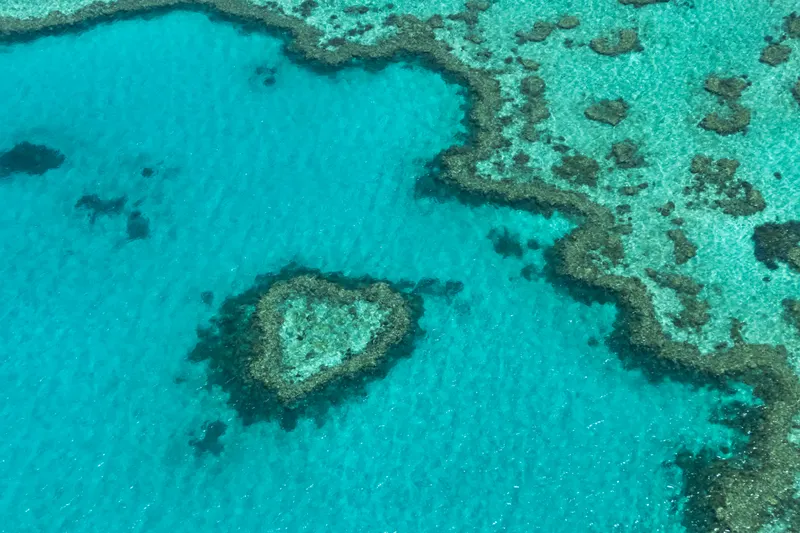
Every ecoregion in several major reef regions is Critically Endangered once projected heat is counted. That includes all 17 in Australia, home to the Great Barrier Reef, all 25 in East Asia, which includes the Coral Triangle, all 10 in the Caribbean and all 13 in South Asia, according to IUCN's regional summaries.
The one collapsed ecosystem has a clear cause. IUCN says the Western Galápagos reefs collapsed after the 1982-83 El Niño event. That makes the current Pacific outlook worth noting. The World Meteorological Organization said in September that El Niño is firmly established, that there is a near-100% likelihood it persists through February 2027, and that it is expected to reach very strong intensity and peak toward the end of 2026. A forecast of strong El Niño is not a forecast of reef death, and impacts vary by region, but it is the kind of heat that this assessment treats as the main risk.
The bright spots and what comes next
There is some good news. IUCN identifies reefs that have been hit by repeated heatwaves but still hold healthy coral, citing the Northern Red Sea, Papua New Guinea, West Kiribati and Bermuda as examples. Even the heat-tolerant Northern Red Sea is Critically Endangered once future warming is included, but IUCN says such sites will be critical to the persistence and recovery of threatened reefs and should be protected as a priority.
The assessment also has a policy role. IUCN notes that the Red List of Ecosystems is a headline indicator of the Kunming-Montreal Global Biodiversity Framework and supports national reporting on its restoration and 30x30 targets. That framework was the subject of the UN biodiversity summit (COP17) in Yerevan, which ended in overtime with a deal but little money after delegates deadlocked over who pays.
That is the uncomfortable part. A new risk ranking has now given governments a baseline for every reef they manage, while the money to act on it remains largely voluntary. The label Critically Endangered is a warning with a window attached. IUCN says that window is closing.
Written by
Mr. Jitendra Bhatt
Msc in Chemistry and field researcher.