Blogerroom
Qualcomm to Pay Huawei for Patents for the First Time
Qualcomm will license Huawei's chip-stacking patents in a cross-license deal. Huawei says its licensing contracts now top $6.9B, reversing 25 years of payments.
Qualcomm is about to pay Huawei for patents, and for 25 years the money flowed the other way. On October 5, 2026, the two companies announced a multiyear cross-license covering 5G, compute, AI and networking. Qualcomm also said it will buy some of Huawei's U.S. patents outright, pending regulatory approval, according to Tom's Hardware's reading of the joint release. Nikkei Asia reported that Qualcomm will be the net payer. A Huawei spokesperson told Bloomberg the package includes patents behind LogicFolding, the chip-stacking technique Huawei unveiled in May.
The royalty flow has reversed
The reversal is the real story, and it is bigger than one contract. Huawei took a royalty-bearing Qualcomm license in 2001 to build CDMA network equipment, Tom's Hardware reports. Huawei stopped paying in 2018, and its general counsel later testified for the FTC in the agency's 2019 antitrust case against Qualcomm. By early 2025 Qualcomm no longer counted Huawei royalties in its revenue because the old license had expired.
Now Huawei says the Qualcomm deal lifts the total value of its patent-licensing contracts above $6.9 billion, counted from its first licensing income from Motorola in 2011. It also says its licensing business has earned more than it spends on other companies' patents since 2021. As of 2025 Huawei held 165,000 active granted patents worldwide. A company that spent years as a licensee is now collecting from the firm that once set its terms.

The announcement names less than the headlines suggest
Neither company's public release mentioned LogicFolding. Only Huawei's spokesperson linked the technology to the deal, in comments to Bloomberg, so the connection rests on one side's word for now. No patent count and no dollar value have been disclosed.
The scope is also narrow in one important way. Huawei told the South China Morning Post the agreement involves no other business cooperation, which implies no chip sales. That matters because Washington revoked Qualcomm's license to sell some hardware to Huawei in 2024, as Tom's Hardware notes. Qualcomm is buying paper, not silicon.
The deal still needs regulatory approval. Bloomberg reported it is subject to FTC review under the Hart-Scott-Rodino Act, which applies above a minimum deal size of $133.9 million this year. Since the value is undisclosed, outsiders cannot yet tell how close the deal sits to that line.
What the LogicFolding numbers show, and one calculation
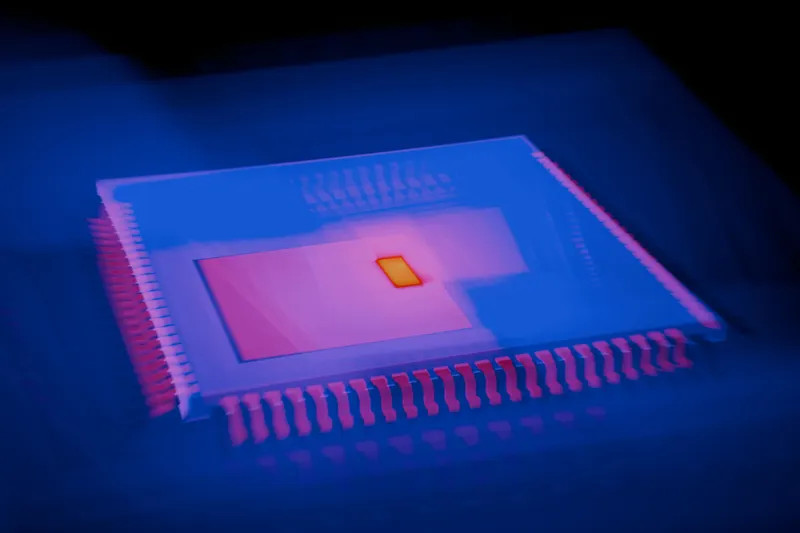
Huawei's claim rests on how finely two chip layers are bonded together. He Tingbo, president of Huawei's semiconductor business, introduced LogicFolding on May 25 at IEEE ISCAS 2026 in Shanghai. A Huawei paper relayed by TrendForce says the chip uses hybrid bonding at a 1.5-micrometer pitch with about 50 million interconnects, and only 10 to 15 percent of them carry signals. That works out to roughly 5 to 7.5 million signal connections between two dies bonded face to face.
Tom's Hardware puts TSMC's SoIC roadmap at a 6-micrometer pitch for 2025 and Intel's Foveros Direct at 9 micrometers. Simple arithmetic shows what Huawei is claiming. A 1.5-micrometer pitch is four times finer than 6 micrometers, and in a uniform grid that means about 16 times as many connections per square millimetre. Against Intel's 9 micrometers, the gap is 36 times.
Treat that as a claim, not a measurement. The pitch figure comes from Huawei's own paper. Ian Cutress, chief analyst at More Than Moore, has argued that the "Tau Scaling Law" Huawei uses to frame the work largely repackages what the industry already does.
Geekerwan's teardown of the Kirin 9050 Pro also shows what the approach costs. Each die measures just over 120 mm², so the pair totals more than 240 mm², about 70 percent above the previous chip's 140-plus mm². Huawei is buying part of its gain with extra silicon, which is a cost Qualcomm's own designers will weigh.
Why Qualcomm would pay for it
Qualcomm's motive is most likely defensive, though nobody has said so. Stacking and co-packaged optics are techniques the whole industry is moving toward, and owning or licensing the patents reduces the risk of a future dispute. No source has named which Huawei patents Qualcomm wants, so this is an inference. John Han, who runs Qualcomm Technology Licensing, described the agreement as recognition of Huawei's intellectual property in 5G and other fields.
There is also a technical contrast worth noticing. Qualcomm's first 2nm phone chip follows the conventional path of shrinking transistors on the most advanced process. LogicFolding is the opposite bet: shrink less, stack more, and shorten the wires instead. Paying for rights to the second approach while shipping the first looks like a hedge against either path winning.
What it means for the export-control argument
The sharpest implication is political. Bloomberg's coverage, as summarized by Tom's Hardware, describes LogicFolding as a way to compensate for China's lack of access to EUV lithography machines. A U.S. chipmaker paying for rights to that workaround suggests export controls pushed Chinese engineering toward a different route rather than closing the road.
That is not proof the route works at scale. Huawei's 1.4nm-class density target is for 2031, its Kirin 2027 chip still has to meet the 1-micrometer pitch the roadmap promises, and independent die analysis from firms such as TechInsights or SemiAnalysis has not yet appeared. The FTC review is the second test. If a U.S. regulator slows or reshapes the deal, the validation story Huawei is telling gets harder to sustain.
The timing is also awkward for Washington. The recent Trump-Xi summit produced no AI agreement, and now two companies have quietly agreed on terms that governments did not. Policy is still arguing about who may buy what, while the patent offices are already trading the results.
Written by
Mr. Aayush Bhatt
Software Engineer with in depth understanding of buliding softwares and Tech.