Blogerroom

CXMT's 4F² Claim Cut Samsung 7.4% Before Any Chip Ships
CXMT says server DRAM on a 4F² cell arrives by year-end. Samsung fell 7.4% and SK hynix over 7% on Oct. 13, yet no specs, yields or volumes exist.
On Saturday, October 10, the president of a Chinese memory company said a product would arrive by the end of the year. By Tuesday, shares of two of the world's biggest memory makers had dropped sharply. CXMT president Cao Kanyu told a Shanghai chip conference that the company's first server DRAM built on a new 4F² cell design is due before 2026 ends, Hardware Busters reports, citing Yicai's coverage of the talk. On October 13, Samsung Electronics fell 7.4 percent, according to CNBC, and SK hynix lost more than 7 percent in Seoul, per Seoul Economic Daily, though CNBC put its closing drop closer to 10 percent. Micron fell roughly 4 percent. Nobody outside CXMT has tested a module.
A cell that is one-third smaller on paper
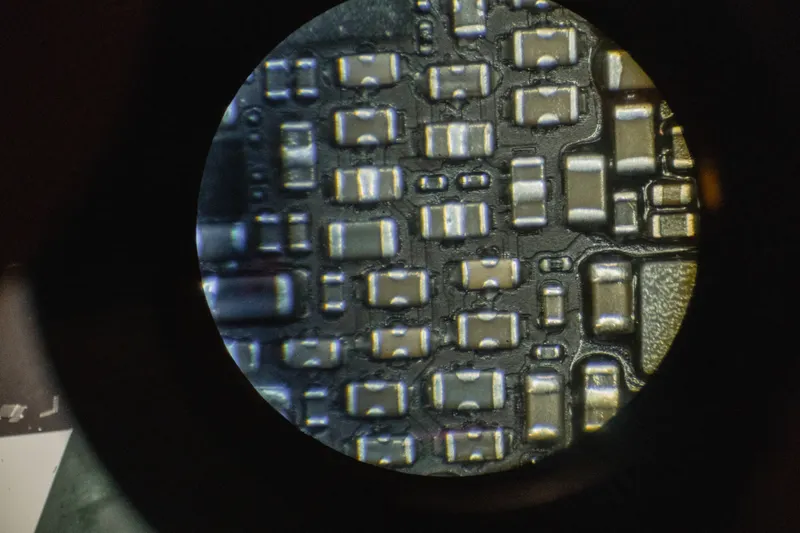
The design change is simple to state. Every DRAM cell is one transistor and one capacitor, and its size is measured in units of F, the smallest feature the process can print. Mainstream DRAM uses a 6F² layout. A 4F² cell is a 2F-by-2F square, so it covers about two-thirds of the area at the same feature size, as Hardware Busters explains.
My arithmetic gives the ceiling. Cutting the cell area from 6 to 4 units means up to 1.5 times as many cells in the same space, a 50 percent gain at best. Industry estimates cited by Wccftech put the real gain at 30 to 50 percent, which fits once circuitry around the cells takes its share.
The hard part is the transistor. It has to stand upright, and the leakage that comes with that has kept vertical-channel DRAM in laboratories for years. CXMT's answer is a Vertical Surrounded Gate transistor, and Cao said the company holds more than 300 published patent families on 4F². The sanctions angle matters too. CXMT cannot buy EUV scanners, so a denser cell is one of the few ways left to raise bit density using the DUV tools it already owns, the same tool class that a Washington think tank estimates China has stockpiled in large numbers.
Why a claim moved a market
On announced timelines, CXMT would be about two years ahead. Samsung showed a 16-gigabit 4F² chip at the ISSCC conference in February but is aiming for mass production around 2028, according to Hardware Busters. CXMT's year-end target leaves about eleven weeks.
The company is no longer a footnote. An HSBC note cited by IBTimes puts its share of global DRAM at roughly 10 percent, up from 4 percent a year earlier, and TrendForce, cited by Hardware Busters, has it at 9.5 percent of second-quarter revenue, fourth behind Samsung, SK hynix and Micron. After a July listing, CNBC reports, its market value sits near 3.46 trillion yuan, or about $520 billion, close to Tencent's.
The timing also hurt. As we reported, Samsung's record profit depended on prices rising about 20 percent in a quarter on only 3.4 percent more DRAM shipments, and the forecasts behind it assume customers keep paying. A new rival aiming at server memory, where margins are highest, attacks that assumption directly.
What CXMT has not said
Quite a lot. Hardware Busters notes there is no stated capacity, data rate, die density, process node, named customer or volume target. Korean reports cited by TrendForce suggest the first products may use 4F² only in part. A launch is not volume production either. Morningstar's Jing Zhewei, quoted by Hardware Busters, expects a meaningful gap between unveiling a 4F² product and reaching profitable yields.
Server customers are slow to approve new memory, and a new cell architecture is exactly what they scrutinize. "By year-end" could mean samples in a cloud provider's lab or modules on a price list. High-bandwidth memory, the most profitable AI product, is also outside this announcement. BigGo Finance says the product is not expected to change the HBM picture immediately, and UBP's Vey-Sern Ling told CNBC Chinese makers still face technology hurdles there.

The sell-off had other fuel
The size of the drop says more about positioning than engineering. Ling also told CNBC that investors were jittery and looking for excuses to take profits on AI-linked stocks that had outperformed this year, especially memory. CNBC adds that the slide extended a sell-off tied to worries over AI financing, after Wall Street also fell on Monday.
A 7 to 10 percent fall in a day over an unverified product suggests the market was already crowded in one direction and needed only a reason to leave. That cuts both ways. If CXMT delivers samples that work, the fear was early rather than wrong. If it slips, as first launches often do, the incumbents will have lost value over a press conference, and the real test comes later, when Samsung publishes full third-quarter results on October 29 and customers start qualifying memory for 2027.
Written by
Mr. Aayush Bhatt
Software Engineer with in depth understanding of buliding softwares and Tech.