Blogerroom
New Egg-Eating Snake Found After 7-Year Investigation
A snake that looked ordinary took seven years and a hybrid breeding experiment to confirm as a new species in Ethiopia's Harenna Forest.
A snake that looked exactly like one already on the books
In May 2019, a local collaborator sent Arthur Tiutenko a juvenile female snake collected in Ethiopia's Harenna Forest. Nothing about it looked unusual. It appeared to be a Montane Egg-eater, Dasypeltis atra, a black, harmless snake already well documented across East African forests. Tiutenko, a researcher at Friedrich-Alexander-Universität Erlangen-Nürnberg, planned to breed it and continue his work as usual. Then the snake grew up, and the picture stopped adding up.
Seven years, one deliberate hybridization experiment, and a full genetic and morphological workup later, that single juvenile has become the basis for a newly described species: Dasypeltis albigularis, the white-throated egg-eater, published in the open-access journal Herpetozoa by Tiutenko alongside colleagues at Ludwig-Maximilians-Universität Munich and South Africa's National Museum in Bloemfontein.
A genus built almost entirely out of impostors
Understanding why this discovery took seven years requires understanding what makes the genus Dasypeltis so difficult to work with in the first place. These are harmless African snakes that survive entirely on a diet of birds' eggs, using specially adapted vertebrae in their throats to crack shells before swallowing the contents whole, a genuinely unusual dietary specialization among snakes generally. But their external appearance offers taxonomists almost nothing useful to work with. Most of the roughly 20 recognized Dasypeltis species are uniformly black, brown, or gray, with few obvious external features distinguishing one species from its close relatives, making the genus a notoriously difficult one for anyone trying to sort specimens by eye alone.
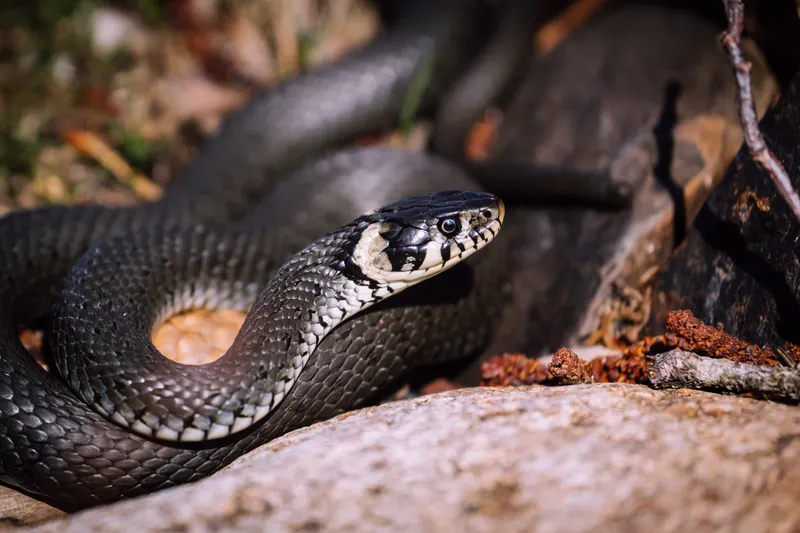
That's precisely the trap Tiutenko's juvenile snake initially fell into. As an infant, it matched D. atra closely enough that there was no obvious reason to suspect otherwise. It was only as the animal matured into adulthood that Tiutenko began noticing details that didn't line up with the species he'd assumed he was looking at: unusually bluish-tinted skin visible between the scales, distinctive white coloring beneath the head and along the front portion of the belly, unusual head scales, and a small additional scale generally absent in egg-eating snakes altogether.
The experiment that actually settled the question
Noticing physical differences is one thing. Proving those differences represent a genuinely distinct species, rather than simple individual variation within a known species, is a considerably higher bar, and Tiutenko chose an unusually direct way to test it. "I received a juvenile female of an egg-eater that appeared to me to be an already known species, and I started looking for a male to breed it," he explained. "As she grew to adult size, I noticed morphological differences." Rather than abandoning the breeding plan once those differences appeared, he pursued it deliberately as a test: "I crossed them nevertheless, to see how the offspring would turn out and how her characteristics would be inherited."
The resulting hybrid offspring displayed a genuine mix of traits inherited from both parents, direct, observable evidence that the Harenna Forest female wasn't simply an unusual-looking individual of the already-known species, but carried a genuinely distinct set of heritable characteristics capable of blending with, rather than simply matching, her mate's traits in the next generation. That's a considerably more rigorous form of evidence than morphological comparison alone could provide, since it demonstrates the differences are real, inherited biological traits rather than superficial individual variation.
Confirming the hunch with genetics and formal description
The hybridization result gave Tiutenko's team early confidence they were looking at something new, but confirming it with a full scientific description required considerably more work: genetic analysis comparing both mitochondrial and nuclear DNA between the new specimen and its closest relatives, detailed morphological comparison across multiple individuals, and years of continued observation. That combined evidence ultimately showed Dasypeltis albigularis and its look-alike, D. atra, are genetically distinct species despite their superficial resemblance, a distinction genetics could confirm with a level of certainty that appearance alone never could.
The new species reaches up to about 92 centimeters in total length for females, with males topping out somewhat smaller at under 60 centimeters, and lives in dense forest habitat between roughly 1,500 and 1,700 meters above sea level. Its name, albigularis, means "white-throated" in Latin, directly referencing the pale ventral coloration on its throat and the front part of its body that first tipped researchers off that something didn't quite match.
Why the Harenna Forest matters as much as the snake itself
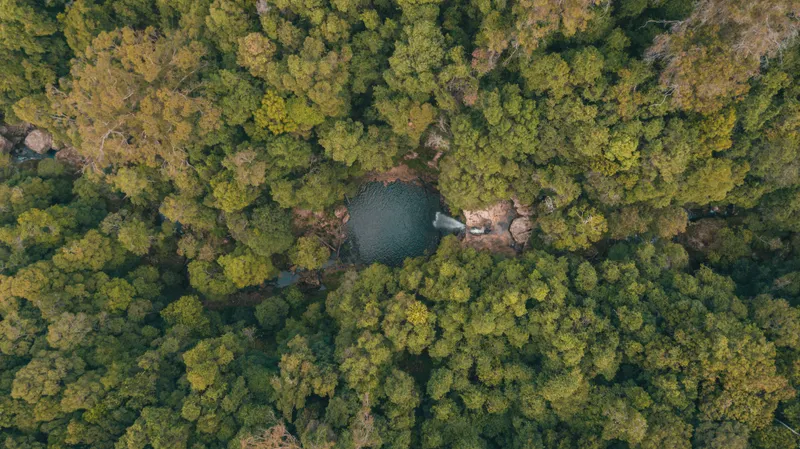
The setting of this discovery carries its own significance. Harenna Forest, located on the southern Somalian plateau in Ethiopia, is described as one of the last substantial tracts of natural forest remaining in the Horn of Africa, a region that has experienced extensive deforestation and habitat conversion across much of its historical forest cover. Finding a genuinely new vertebrate species there isn't purely a taxonomic curiosity; it's a direct data point demonstrating that this specific, increasingly rare forest ecosystem still harbors undiscovered biodiversity, evidence that strengthens the case for protecting what remains of it before further habitat loss potentially eliminates species before they're ever formally documented.
That's a recurring pattern across taxonomy generally: species discoveries in shrinking, poorly surveyed habitats often function as evidence for conservation priority as much as scientific curiosities in their own right. A forest that can still produce a genuinely new snake species after presumably decades of at least some biological survey work is a forest whose remaining undocumented biodiversity is worth taking seriously before further degradation.
What this case says about how many species remain hidden
Tiutenko's seven-year investigation illustrates a broader challenge running through modern taxonomy: distinguishing genuinely separate species from look-alikes has become considerably more rigorous, and considerably slower, as genetic tools have raised the evidentiary bar for what counts as a confirmed new species. A century ago, distinctive coloration or an obvious anatomical feature might have been sufficient grounds for naming a new species. Today, particularly within notoriously uniform-looking genera like Dasypeltis, researchers increasingly need genetic confirmation, and in this case, direct breeding evidence, before a description holds up to scientific scrutiny.
That higher bar makes discoveries slower and more resource-intensive to confirm, but it also makes them considerably more reliable once published. Given that Dasypeltis already contains around 20 recognized species specifically because so many of its members are difficult to visually distinguish from one another, it's a near certainty that further genetic and breeding work across the genus's range will continue turning up additional cryptic species hiding within populations currently lumped together under existing species names, each one likely requiring its own multi-year confirmation process before formal recognition, much like the seven years Tiutenko's single juvenile snake ultimately demanded.
Written by
Mr. Jitendra Bhatt
Msc in Chemistry and field researcher.