Blogerroom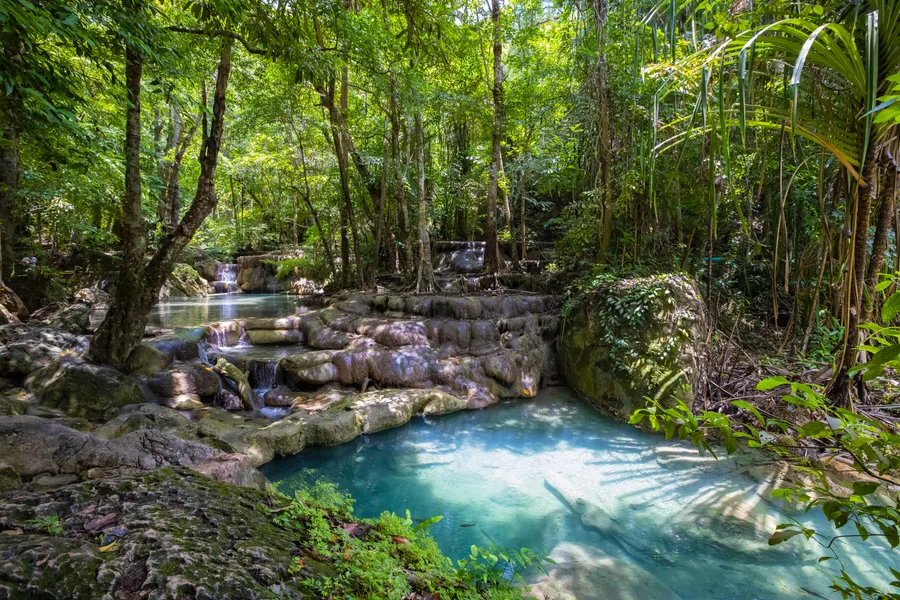
Rare 'Devil Flower' Discovered Hiding in Thai Forest
Botanists found Thismia daemona, a black, leafless "devil flower" in Thailand, known from fewer than 50 individuals in one population.
A flower that spends almost its entire life hidden
For most of the year, a small patch of forest floor in western Thailand keeps a genuine secret buried beneath its leaf litter. Then, briefly, a strange black flower pushes up into view, horned, dome-shaped, and marked with fiery orange patches that read almost like a pair of glowing eyes. Botanists surveying Thong Pha Phum National Park have now formally described that flower as a new species, and given it a name that matches its appearance without much subtlety: Thismia daemona, the "devil flower."
The discovery, published this week in the open-access journal PhytoKeys by a research team including Tosak Seelanan, Isareyakorn Chantapram, Neeranuch Taosiri, Chanachon Chuchuea, and Sahut Chantanaorrapint, from Chulalongkorn University and Prince of Songkla University, brings the total number of Thismia species recorded in Thailand to 16. But the significance here extends well past a single addition to a regional plant list.
A plant that gave up on sunlight entirely
Thismia daemona belongs to a genus sometimes called "fairy lanterns," small plants scattered across tropical forest floors worldwide, unified by one genuinely unusual trait: they contain no chlorophyll and cannot photosynthesize. Instead of drawing energy from sunlight the way almost every other plant does, Thismia species survive through a relationship called mycoheterotrophy, drawing nutrients directly from underground fungi rather than manufacturing their own food. That dependency is why these plants spend nearly their entire lives hidden beneath leaf litter, emerging only briefly to flower and reproduce before disappearing back underground.
That lifestyle explains why species in this genus go undetected for so long, even in reasonably well-surveyed forests. A plant that doesn't need light has no evolutionary incentive to grow tall, spread leaves, or otherwise make itself visible above the forest floor. Finding one at all typically requires being in exactly the right place during the narrow window when it briefly flowers, which is precisely the kind of chance encounter that drives new Thismia discoveries even in national parks that receive regular botanical attention.
Why the appearance earned such a dramatic name
Dr. Sahut Chantanaorrapint of Prince of Songkla University described the moment of discovery as genuinely surprising, calling the find in Thong Pha Phum National Park "a major surprise." The flower's design is distinctive even by the already-strange standards of the Thismia genus: mostly black, with horn-like appendages crowning a dome-shaped structure botanists call a "mitre," and patches of vivid reddish-orange near its base that give the impression of a demon's glowing eyes. Chantanaorrapint explained the naming decision directly: "Combined with its hidden, subterranean and mysterious lifestyle on the forest floor, our team unanimously agreed that naming it Thismia daemona perfectly captured its enigmatic and devil-like essence."
That kind of vivid, evocative naming has become an increasingly common and deliberate choice among taxonomists describing new species, since a memorable name draws public attention, and public attention, in turn, tends to translate into greater awareness of the conservation challenges facing newly described, often extremely rare organisms.
An elevation that surprised even the specialists
Beyond its appearance, Thismia daemona's habitat carries its own scientific significance. The species was found growing at an elevation of nearly 1,000 meters, in a seasonally dry mountain forest setting that stands apart from the humid lowland environments where most Thismia species are typically documented. That's a meaningfully different ecological niche than researchers expected for this genus, and it raises a real possibility that other Thismia species remain undiscovered in similarly atypical high-elevation habitats that botanical surveys have historically underprioritized, precisely because researchers assumed the genus stuck to lowland, humid forest.
The discovery also carries a biogeographic significance extending well beyond Thailand's own borders. Thismia daemona belongs to a specific taxonomic subdivision, Thismia section Geomitra, previously known only from Peninsular Malaysia, Borneo, and Sumatra. Its presence in western Thailand pushes the known geographic range of that entire section northward for the first time, a genuinely notable expansion for a taxonomic group that researchers had assumed was geographically confined to islands and peninsular habitats further south.
Rare from the moment it was named
Unlike many newly described species, whose actual population size remains unknown until further surveys are conducted, Thismia daemona arrived already flagged as critically vulnerable. Researchers report the species is known from a single population containing fewer than 50 individual plants, a scarcity that places it immediately among the more precarious newly described species in recent memory. A single known population confined to one national park means the entire species could plausibly be wiped out by one localized disturbance, whether from habitat degradation, an unusually severe seasonal drought, or even, ironically, the kind of increased foot traffic that publicity around a dramatically named new discovery can sometimes bring to a previously obscure patch of forest.
That vulnerability is compounded by the species' own biology. A plant that depends entirely on an underground fungal partner for survival is only as resilient as that fungal relationship and the surrounding soil ecosystem supporting it; disturbances that might seem minor to a photosynthesizing plant, changes to soil fungal communities, shifts in leaf litter composition, or alterations to the forest canopy affecting fungal growth, could threaten a mycoheterotrophic species in ways that wouldn't register as an obvious, visible threat to casual observers.
What this discovery adds to a broader pattern
Thismia daemona's story fits into a wider pattern showing up repeatedly across recent botanical and zoological discoveries: genuinely novel, evolutionarily distinct organisms continuing to turn up in specific, narrow habitats that happen to have received less thorough scientific attention than better-studied regions nearby. Southeast Asia's forests, spanning a wide range of elevations, seasonal patterns, and microhabitats packed into relatively compact geographic areas, have proven especially productive for this kind of discovery, precisely because so much variation exists across short distances, and because comprehensive botanical surveys covering every elevation band and forest type remain genuinely incomplete even in well-protected national parks.
For a genus already known for species that spend nearly their entire existence out of sight, finding Thismia daemona in an atypical high-elevation, seasonally dry setting rather than its expected humid lowland habitat suggests botanists may need to widen where they look for the genus's remaining undiscovered members. Given how rare and habitat-specific this newly named species already appears to be, the practical challenge ahead isn't really about finding more devil flowers. It's about protecting the one population that's already been found before anything happens to the fragile underground network of soil and fungi it depends on to survive.
Written by
Mr. Jitendra Bhatt
Msc in Chemistry and field researcher.