Blogerroom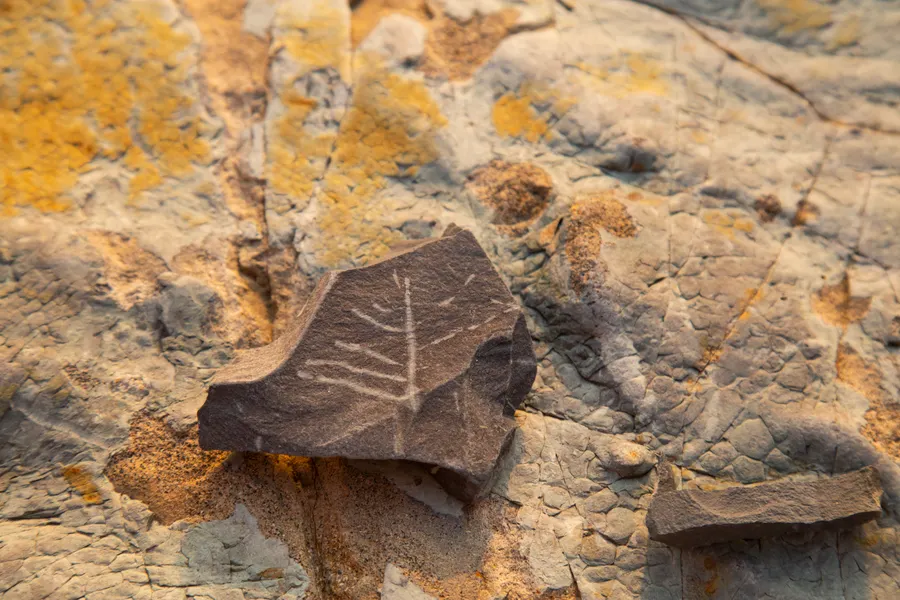
A Feather in Dinosaur Poop Explains Why Birds Survived
A 66-million-year-old feather found inside fossilized dinosaur feces may explain why only one bird lineage survived the asteroid impact.
A meal preserved by pure accident
About 66 million years ago, a large dinosaur, quite possibly a Tyrannosaurus rex or its smaller relative Nanotyrannus, ate a bird. That single meal, digested and excreted millions of years before anything resembling a human existed, happened to fossilize under exactly the right conditions to preserve fragments of the bird's feathers inside the resulting dropping. A study published in Current Biology reports that this fossilized feces, or coprolite, contains what researchers describe as the finest feather specimen yet discovered from the entire age of dinosaurs, and it may help resolve one of paleontology's more stubborn mysteries: why one narrow branch of the bird family tree survived the asteroid impact that wiped out every other dinosaur lineage.
Jingmai O'Connor, the study's lead paleontologist, has spent years studying fossil birds trying to understand that survival puzzle, but this particular investigation took her into genuinely uncharted territory. "As far as I know, no one has ever thought to look for feathers or to study feathers in coprolites, so this project was really exciting," O'Connor said.
A lucky break, literally
The specimen itself was discovered back in 2016 by David DeMar Jr., but its scientific value didn't become apparent until years later, and even then, only by chance. The coprolite looked like an unremarkable lump of fossilized material, the kind of specimen that could easily sit in a collection drawer for decades without anyone examining it closely. What made this particular one worth a second look was how it happened to be split open, exposing a feather directly on its surface. "We only knew to look at this one because of how it happened to be split open, with the feather exposed, it was literally a lucky break," O'Connor said.
That's a familiar pattern in paleontology, where genuinely significant fossils often sit unrecognized for years until either new technology or a moment of chance draws researcher attention to a detail that had gone unnoticed. Paleontologist Nate Carroll, who had previously studied feathers preserved in amber from Myanmar during his graduate work, recognized that the feather trapped in this ordinary-looking coprolite was better preserved than many of the amber specimens he'd already spent years analyzing.
What micro-CT scanning revealed inside an ordinary-looking lump
Once the team suspected they had something significant, they turned to micro-CT scanning, a high-resolution imaging technique that let them examine the coprolite's internal structure without physically destroying it. What that scan revealed went well beyond the single feather visible on the surface. "Every hour processing the data revealed another feather, another scale, another bone, in stunning 3D," Carroll said. That kind of layered internal detail is exactly what a destructive dissection would risk damaging or losing entirely, making the non-invasive scanning approach essential to actually recovering the full scope of what the fossil preserved.
The feathers found inside the coprolite belong to a hesperornithiform, an extinct group of toothed, diving birds distantly related to modern loons and grebes in general body plan, though not directly ancestral to them. Notably, these are the first hesperornithiform feathers ever recovered in the fossil record, a genuinely significant gap in the evidence that this single specimen closes.
The detail that connects a feather to a mass extinction
The scientific payoff here comes down to a specific physical feature. Two of the recovered feathers, including the one originally exposed on the coprolite's surface, show a square feather shaft with a sponge-like internal center, a structural detail found only in the feathers of living birds and their most immediate evolutionary ancestors. DeMar was explicit about how unusual that combination is in a fossil this old: "No other Mesozoic feather has this combination of features." The next-oldest known example of that same sponge-like shaft structure comes from the early Eocene period in Denmark, roughly 10 million years younger than this newly described specimen from Montana's Hell Creek Formation.
That timing matters enormously for the survival question driving the research. The hesperornithiforms' feathers appear to represent a genuine middle ground between the more primitive feathers of enantiornithines, an entirely different and now-extinct bird lineage, and the fully modern feather structure found in Neornithes, the single bird group that survived the extinction event and gave rise to every bird alive today. O'Connor described the mixed nature of what the team found directly: "Some of these diving birds' feathers seem to have been modern-looking and waterproof, but they also had some smaller, fuzzy, primitive body feathers that we associate with dinosaurs and enantiornithines."
Why insulation may have been the deciding factor
The connection between feather structure and survival rests on a fairly direct physical mechanism: feathers that trap body heat more effectively provide better insulation, and insulation would have mattered enormously in the aftermath of an asteroid strike capable of triggering a prolonged, dramatic global cooling event, commonly referred to as impact winter. Nearly every dinosaur lineage, including the overwhelming majority of bird species alive at the time, went extinct in that aftermath. Only Neornithes made it through.
If hesperornithiforms and enantiornithines both carried feathers less effective at retaining body heat than the feathers found in Neornithes, that structural gap could represent a genuine, physically grounded explanation for why one bird lineage survived a catastrophe that eliminated so many close evolutionary relatives. Since hesperornithiforms belong to neither the Neornithes nor the enantiornithine lineages, this newly described feather also helps place an intermediate data point on the evolutionary map, clarifying how feather insulation quality was distributed across the broader bird family tree in the moments before the extinction event actually struck.
Why this specimen adds real weight to a long-debated theory
The insulation-survival hypothesis for explaining Neornithes' unique survival isn't new to this study; researchers have floated versions of this explanation for years as one plausible factor among several competing theories. What this coprolite specimen adds is something the field has genuinely lacked: direct physical evidence of feather structure from exactly the geological moment in question, preserved through an entirely unconventional pathway that nobody had previously thought to search. Gregory Wilson Mantilla, a University of Washington researcher and curator at the Burke Museum who worked on the study, emphasized how rare a find of this kind actually is: "We rarely find fossils of birds and even more rarely their feathers, giving us such important insight into the evolution of this key aspect of their biology."
A new place to look for old evidence
Perhaps the study's most practically useful contribution extends beyond this single specimen entirely. O'Connor, more accustomed to working with complete fossil skeletons, described the shift in approach this project required: "It made me feel like a detective, piecing together all these little clues." She's now hoping other researchers will start actively scanning coprolites specifically in search of preserved feathers, treating a source of fossil evidence that's been essentially overlooked for the entire history of paleontology as a genuine, underexploited research avenue going forward.
That's a meaningful methodological opening. Coprolites are relatively common in the fossil record compared with complete feathered specimens, and if even a modest fraction of them preserve identifiable feather fragments the way this one did, researchers could have access to a considerably larger dataset of Mesozoic feather structure than the current fossil record, dominated by rare amber inclusions and exceptionally preserved skeletal specimens, has ever offered. A discovery that began with one paleontologist noticing an unusually well-preserved feather poking out of an otherwise unremarkable fossilized dropping may end up reshaping where an entire field decides to look for its next major clue.
Written by
Mr. Jitendra Bhatt
Msc in Chemistry and field researcher.