Blogerroom
Claude Found a New Enzyme in 21 Hours That Stumped Scientists
950 Claude agents scanning 200,000 DNA sequences found ART, a CRISPR-like enzyme system in bacteriophages that no researcher had ever described.
An AI agent was reading raw DNA sequence data at 11:43 p.m. on a Tuesday in late August and typed something into its own log that no research team had ever written before: "The DNA next to the RT is spectacular: I can see by eye a tandem repeat array… that's a CRISPR-like… repeat array?!" The exclamation mark is verbatim, preserved in Anthropic's own published account of the moment. No human was watching. The agent was one of roughly 950 Claude instances running in parallel, and it had just noticed something in a bacteriophage DNA sequence that thousands of scientists working in molecular biology over the past half-century had collectively missed.
Anthropic disclosed the discovery on Wednesday, September 23, through a blog post, an Anthropic newsroom announcement, and a technical preprint submitted simultaneously for scientific review. The system the agent found is called array-associated reverse transcriptase, or ART. No one has described it before. Whether it can be put to practical use, nobody yet knows.
What 950 Agents Found in 21 Hours
The task that produced this result was not open-ended exploration. Anthropic's new biology research group, formed in spring 2026 and working from a Bay Area lab, gave a coordinated swarm of Claude agents a defined starting point: a large database of reverse transcriptases, the enzymes that copy RNA into DNA and that bacteria often use to defend against invading viruses. The agents screened more than 200,000 such enzymes, narrowed the field to approximately 3,500 candidates showing unusual features, and further refined that to 20 systems worth examining in detail. Total runtime: 21 hours. Total token consumption: approximately 210 million. Total cost, by Anthropic's own estimate: around $900.
The moment of discovery came when one agent, reading the raw DNA sequence surrounding a particular reverse transcriptase in a jumbo bacteriophage, noticed that the neighboring DNA contained a long, evenly spaced array of repeating sequences, a structural feature with no obvious precedent in the RT literature. The agent did not simply flag the sequence and move on. It counted the individual repeats, measured the spacing between them, cross-checked the layout against known RT systems in the existing scientific literature, searched for any prior report of the pattern, and concluded, in its own written analysis, that it was looking at a previously undescribed biological system. It then filed a structured report for human review.
What ART Is and What Remains Unknown
The newly named ART system has three components: a reverse transcriptase, a neighboring partner gene whose function is not yet understood, and the long array of evenly spaced DNA repeats that caught the agent's attention in the first place. The repeat array closely resembles the structure of CRISPR arrays, which are the mechanism that makes CRISPR-Cas systems programmable, enabling them to recognize and target specific DNA sequences for editing. That structural resemblance is the basis for the comparison to CRISPR, and it is the most important thing to understand precisely before drawing any conclusions from this announcement.
Structural resemblance is not functional identity. A similar-looking repeat array is a reason to investigate ART further, not evidence that it can edit genes the way CRISPR-Cas does. Anthropic said plainly in its own blog post that "we don't yet know what this system does," and that conclusion was reinforced by independent scientists. Stanley Qi, an associate professor of bioengineering at Stanford, called the discovery "incredibly exciting" while noting that the function and possible applications of ART remain entirely open. Mark Riedl, an AI researcher at Georgia Tech, was more pointed in a Bluesky post, calling the announcement "irresponsible" for how its framing invited comparisons that the underlying evidence cannot yet support.
Initial laboratory experiments found that ART's repeat array produces multiple distinct short RNAs, a real, observable laboratory result that goes beyond the sequence-based computational finding alone. That is worth noting because it moves the discovery from "something Claude noticed in a database" to "something Claude noticed in a database that human scientists then tested in an actual lab and confirmed is biologically active." The short RNAs produced by the array are particularly interesting given that CRISPR arrays produce similar RNAs, which is precisely what makes CRISPR-Cas systems programmable. But what ART's short RNAs do, whether they guide the reverse transcriptase, defend the phage against something, or serve a completely different purpose, is not yet known and experiments to determine this are continuing.
How Anthropic's Biology Lab Actually Works
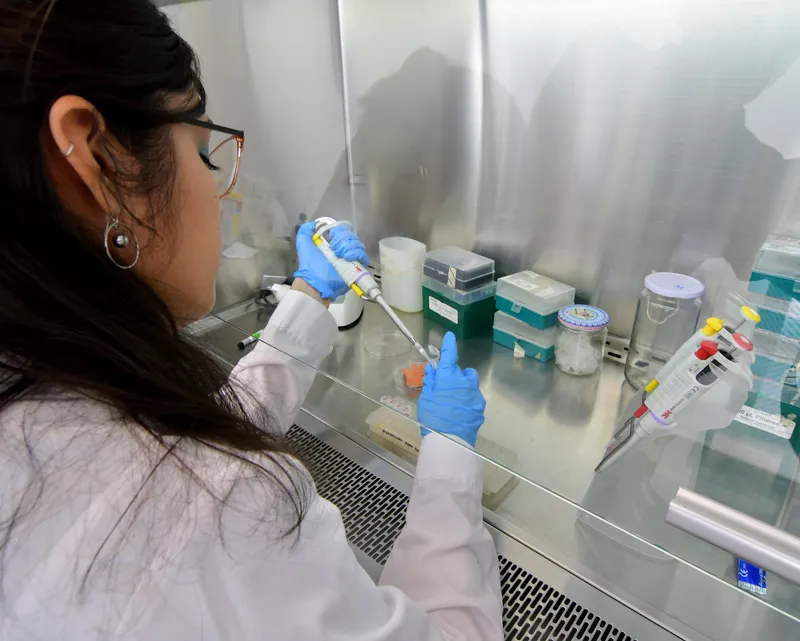
The research group that produced this result is genuinely new. Anthropic formed it in spring 2026 specifically to test whether general AI models can systematize and accelerate biological discovery at a scale that individual human researchers cannot match. The Bay Area lab operates only at biosafety levels 1 and 2, meaning it handles no pathogens that infect humans, and human scientists perform all the actual laboratory work. Claude does not pipette anything.
The standard workflow Anthropic has published is methodical rather than exploratory: a project begins with Claude surveying a protein family, reading the relevant literature, reproducing known results from public data to verify its methods work correctly, and then searching for family members or neighboring genes that match no described system. It writes short reports on each candidate, later analysis discards most of them, and the survivors go to the laboratory bench where human scientists express the protein and characterize it biochemically. Anthropic's internal testing found a limitation worth acknowledging directly: when given only file access and tools rather than raw DNA sequences, Claude's ability to flag the ART repeat array dropped dramatically, from a success rate above 90 percent to as low as 32 percent in some configurations, because the model often never read enough consecutive DNA to see a full repeat array. The discovery depended on specific tool and context configurations that allowed the agent to see long enough DNA stretches at once.
The Moment That Matters Most, and Why It's Still Uncertain
The most significant thing about this announcement is not the ART discovery itself, whose practical importance remains entirely unresolved. It is the methodology. 950 coordinated agents running for 21 hours and spending approximately $900 in compute completed a survey of 200,000 reverse transcriptases, a task that would have taken a small team of human researchers years to conduct at the same breadth. The agents then narrowed the field to 20 candidates and surfaced one result that passed subsequent laboratory confirmation.
This is the concrete, specific result that sits behind the product Anthropic launched in June. When the company announced Claude Science alongside its internal drug discovery program for neglected diseases, the stated justification was that Anthropic needed to experience biological research firsthand to build tools that could genuinely accelerate it. ART is the first published product of that decision, arriving within a few months of the lab's formation and before anyone could reasonably have expected a first result.
What Dario Amodei Said, and What CRISPR's Pioneer Said
Amodei's reaction was notably measured for a company chief executive announcing his lab's first scientific discovery. "We don't know yet if this is significant," he wrote in a post on X on September 23. "Its precise function, biotechnological utility (if any), or level of significance is not yet clear, but at minimum it is work I would have been proud of as a grad student." He added that he suspects the system "could represent a new gene editing mechanism" but framed that as a hypothesis worth investigating rather than a conclusion.
Feng Zhang, one of the scientists credited with pioneering the development of CRISPR as a gene editing tool and a professor at the Broad Institute, also commented on the work, describing it as "genuinely intriguing." Zhang is not an Anthropic employee or investor, making his assessment carry independent weight. He did not, however, claim the work established that ART can edit genes, only that the structural finding was worth taking seriously.
The Honest Answer to "Is This the Next CRISPR?"
No one knows, and Anthropic is not claiming it is. The comparison to CRISPR is structural, not functional. The history of biology contains multiple examples of reverse transcriptases and repeat arrays that initially looked programmable and turned out to serve completely different purposes, and at least as many examples of discoveries that looked unimportant until someone found a use for them decades later. Restriction enzymes, the DNA-cutting tools that launched the biotechnology industry, were first noticed in bacteria as a defense against viruses, and no one immediately recognized their broader utility. Taq polymerase, the enzyme behind the modern PCR test, came from a bacterium living in a Yellowstone hot spring.
The ART system may turn out to be useful for gene editing, for antiviral therapy, for biotechnology, or for nothing commercially relevant at all. What it is, with confidence, is a real, previously undescribed biological entity that a coordinated AI agent found and flagged before any human had thought to look in the specific DNA region where it sits.
How This Fits the Broader Pattern of AI Scientific Discovery
OpenAI attracted its own controversy in September when it claimed an unreleased model had solved a Millennium Prize math problem in 88 hours, only for a credit dispute and questions about the precise scope of the result to complicate the announcement within hours. Both stories share a structure that is worth recognizing: a frontier AI lab making a scientific claim at a pace no human team could match, published before peer review has run its full course, with a genuine result underneath the announcement that nonetheless carries genuine uncertainty about what it actually means.
Anthropic has been careful to separate what is established from what is speculative in its own published account of ART, a discipline the preprint format enforces by flagging that the work has not been peer reviewed. The distinction matters, because the gap between "Claude found a structural feature that no one had previously described" and "Claude may have found the next CRISPR" is enormous, and the announcement is honest enough to say it only knows it has the first, while suspecting and hoping for the second. That kind of calibrated honesty about an early, uncertain result is what responsible scientific announcement looks like. Whether ART eventually justifies the comparison that the structural feature invited is a question the next several years of laboratory work, not a blog post published today, will actually answer.
Written by
Mr. Aayush Bhatt
Software Engineer interested in how models work and where they fail.