Blogerroom
Intel Foundry Lands First Named Customer: Fortinet
Fortinet became Intel Foundry's first named outside customer under CEO Lip-Bu Tan, sending Intel shares up more than 8%.
For more than a year, Intel's foundry business has had a simple, embarrassing problem: its biggest customer was itself. On Tuesday, July 21, 2026, that changed, at least on paper. Intel and cybersecurity firm Fortinet announced that Fortinet will build its next flagship firewall chip using Intel's manufacturing process, marking the first time CEO Lip-Bu Tan's foundry turnaround has produced an outside customer willing to put its name on the deal.
Intel shares jumped more than 8% on the news, arriving just two days before the company reports second-quarter earnings on July 23. That timing wasn't lost on investors. A foundry announcement landing right before a quarterly report that will include external foundry revenue numbers is either a confident signal or a well-placed one, and probably both.
The Name Intel Finally Got to Say Out Loud
Tan took over Intel in March 2025 inheriting a foundry business burning enormous sums with almost nothing to show external investors in terms of named commitments. He told investors in May that multiple customers were already working with the foundry, but his stated policy at the time was not to name them. Fortinet breaks that silence. It's now the first corporate customer Intel has been willing to publicly attach to its foundry business since Tan arrived, and the first cybersecurity company ever named as an Intel foundry client.
That matters beyond the specific deal size, which neither company disclosed. A foundry lives or dies on its ability to convert private conversations into public commitments, because customers evaluating a contract manufacturer want proof that other serious companies have already made the bet. For over a year, Intel had no proof point to show. Now it has one.
What Fortinet Is Actually Buying
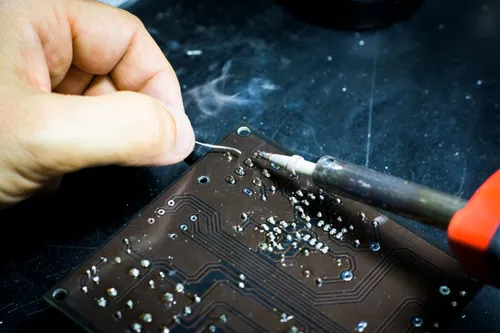
The chip in question is Fortinet's Security Processor 6, custom silicon that will power its FortiGate firewalls. Intel isn't just manufacturing the chip. According to the joint announcement, Intel will also handle co-design work and advanced packaging, putting it deeper into Fortinet's chip development process than a pure manufacturing contract would. Fortinet founder and CEO Ken Xie described the partnership as meant to accelerate and strengthen the company's broader custom-silicon strategy, a strategy Fortinet has pursued for roughly two decades, an unusually long commitment to designing its own chips rather than buying off-the-shelf processors.
The move also has supply chain implications worth noting. Fortinet's current chip, the SP5, is a 7-nanometer Arm-based processor built through contract manufacturers tied to TSMC's production network, according to the company's own 2025 annual report. Shifting SP6 onto Intel's process means Fortinet's next flagship security chip moves out of a TSMC-linked supply chain and into Intel's, a meaningful diversification move for a company that depends on that chip working reliably at scale.
Why the Node Matters as Much as the Customer
SP6 will be built on Intel 4, a manufacturing process Intel had, until this deal, reserved exclusively for its own products. That detail is arguably more significant than the Fortinet name itself. Intel 4 entered high-volume production back in September 2023 at Intel's Fab 34 facility in Leixlip, Ireland, initially producing compute tiles for Meteor Lake-based Core Ultra chips. Opening that node to an outside customer for the first time signals Intel is willing to let external partners onto proven manufacturing lines, not just its newest, riskiest processes.
There's a financial subplot here too. Intel sold a 49% stake in the Leixlip facility to Apollo-managed funds for $11.2 billion back in June 2024, a move that helped fund its turnaround during a cash-strapped stretch. In April 2026, Intel bought that stake back for $14.2 billion, financed through a mix of cash and new debt. Reclaiming full ownership of the fab where Intel 4 chips get built, then almost immediately opening that same node to an outside customer, reads like a company positioning its manufacturing footprint for exactly this kind of deal.
A Small Deal for a Foundry Still Proving Itself
None of this should be mistaken for Intel suddenly rivaling TSMC. Intel Foundry generated just $174 million in external revenue last quarter, a figure that puts the scale of this business in blunt perspective. In an April 2026 regulatory filing, Intel acknowledged it was still chasing what it called a significant customer for its most advanced manufacturing technology, the 18A and 14A processes that actually justify the enormous capital spending behind Intel's new US fabs. Fortinet's SP6 isn't running on either of those advanced nodes. It's running on Intel 4, a mature, already-proven process, which makes this a real win but not the marquee, cutting-edge customer Intel still needs to land.
Other partial commitments exist in the background. Microsoft and Amazon both announced foundry arrangements with Intel under previous CEO Pat Gelsinger, though both were described as relatively low-volume. Intel is also working with Google on custom infrastructure processor design and helping build a chip factory, called Terafab, for Elon Musk's Tesla and SpaceX ventures. President Trump said in June that Apple would manufacture chips through Intel, though neither company has confirmed that deal publicly.
Real Progress, Not Yet the Proof Intel Needs
Intel stock is up 278% so far in 2026, a rally partly fueled by the US government taking a 10% equity stake in the company back in August 2025. That kind of run-up raises the bar for what counts as meaningful news. Fortinet is a legitimate, verifiable customer win, the first Intel has been able to name in over a year of promising them. But it's a mature-node deal for a mid-sized cybersecurity firm, not the flagship smartphone processor or AI accelerator that would prove Intel's newest, most expensive fabs were worth building. Thursday's earnings report will show whether Fortinet is the first domino in a real pipeline, or a well-timed headline arriving just before a market that's already priced in a turnaround demands to see the numbers behind it.
Written by
Mr. Aayush Bhatt
Software Engineer with in depth understanding of buliding softwares and Tech.