Blogerroom
Poland's Top Court Chief Suspended as Tusk, Nawrocki Clash
Judges backed by Poland's ruling majority suspended the Constitutional Tribunal's president on Oct. 30, igniting a clash between Tusk and Nawrocki.
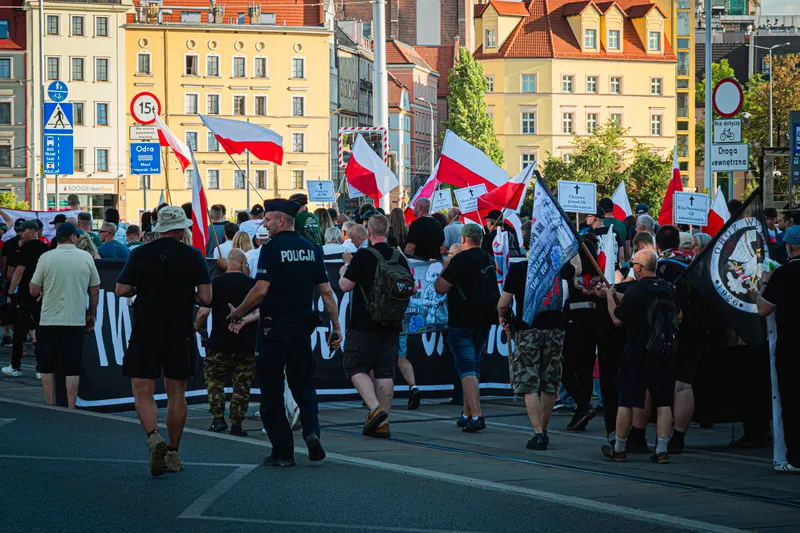
Riot police stood outside Poland's Constitutional Tribunal in Warsaw on Friday night, Oct. 30, while hundreds of protesters pressed against the fence. Inside, a fight that has run for a decade had just taken a sharper turn: the court's own website announced that its president, Bogdan Święczkowski, was suspended.
By Saturday, the country's prime minister and its president were publicly on opposite sides of what one of the president's aides called a massive constitutional crisis. The other side calls it the long-overdue repair of a captured court. Both descriptions are doing political work.
What happened on Friday
According to Al Jazeera, Judge Anna Korwin-Piotrowska announced one-month suspensions of Święczkowski and his deputy, Bartłomiej Sochański, and said she was taking over the running of the tribunal. The judges who backed the move were elected by the current parliamentary majority.
Her authority is disputed. Al Jazeera reports that questions have arisen over whether she can act as head of the court, because her claim rests on total judicial service rather than time on the tribunal itself. Separately, Justice Minister and Prosecutor General Waldemar Żurek took steps that could lead to criminal proceedings against the two suspended judges. Law and Justice (PiS), the main opposition party, says those steps are politically motivated.
Police said they detained three protesters after some threw objects at officers and tried to break through the security fence, the Associated Press reported. The tribunal itself called the episode a judicial "coup d'état," according to Euronews.
A court with a contested bench
The roots go back to 2015. Al Jazeera's explainer notes that the outgoing parliament that year elected five judges, but the tribunal later found only three of those appointments had a valid legal basis. The incoming PiS majority then elected replacements, including for seats lawfully filled, and then-President Andrzej Duda declined to swear in the three valid judges.
The current standoff is the mirror image. This year parliament elected eight judges to the 15-member tribunal. President Karol Nawrocki, a PiS ally, administered the oath to three and withheld it from five, who took their oaths without him, according to Al Jazeera. Święczkowski refused to let those five begin hearing cases. That refusal is what the government cites as the reason for acting against him.
Outside opinion on the court itself is less divided than the politics. The Court of Justice of the European Union ruled in December 2025 that the tribunal did not meet the requirements of an independent court, as Al Jazeera and the AP both note.
Two stories about the same night
Prime Minister Donald Tusk has not hedged. "There is no other way," he wrote on X on Friday evening, calling the restoration of the rule of law an obligation after years of lawlessness under PiS. On Saturday, he compared PiS to a thief who complains once police recover the stolen purse.
Nawrocki turned his plane around en route to Senegal and went to the tribunal overnight, saying he helped the suspended president enter the building, according to the AP. He called talks with parliamentary parties on Saturday. Representatives of Poland 2050 and the Polish People's Party (PSL), two of Tusk's coalition partners, attended; Tusk did not.
That attendance is the detail to watch. The president's camp is openly hoping the crisis will erode Tusk's majority, the AP reported, and Nawrocki's aide Marcin Przydacz put it bluntly: everything depends on the parties that have backed Tusk so far. Coalition arithmetic has become the story, much as it has in Thailand, where a censure vote turned on which smaller parties would hold the line.
The government's own weak spot
It would be easy to cast this as a clean contest between the rule of law and its enemies. The government's own record complicates that. Al Jazeera notes that in September the ruling majority elected Maciej Berek, a former minister in Tusk's cabinet, to the tribunal, and that some coalition members objected because it contradicted promises to depoliticise the judiciary.
Marcin Matczak, a prominent Polish lawyer quoted by Al Jazeera, drew the sharper conclusion. PiS is defending its remaining institutional stronghold, he said, and the government wants to restore balance. But he warned that scenes of police at a court could set a precedent, with a future government pointing to them as proof that sending officers in is an acceptable way to settle a legal dispute.
That is the real cost. Even if Tusk is right on the law, the method hands his opponents an argument for the next time they hold power.
What to watch next
The first flashpoint is close. Matczak told Al Jazeera that a meeting of tribunal judges has been called for Nov. 3, where attempts to lift immunity could deepen the confrontation if the assembly's composition or quorum is challenged.
Beyond that, Poland votes in a parliamentary election next year, and Matczak suggested Tusk may be taking a harder line to energise supporters frustrated by slow reform, a strategy he called risky because it may also alienate moderate voters. Vetoes from two successive PiS-aligned presidents have blocked the government's judicial reforms since 2023, according to the AP, which is the government's case for choosing a harder route. Whether that route holds now depends on a coalition whose smaller partners have not yet said where they stand.
Written by
Dr. Anand Sharma
Deep Understanding of domestic and international policy.