 Blogerroom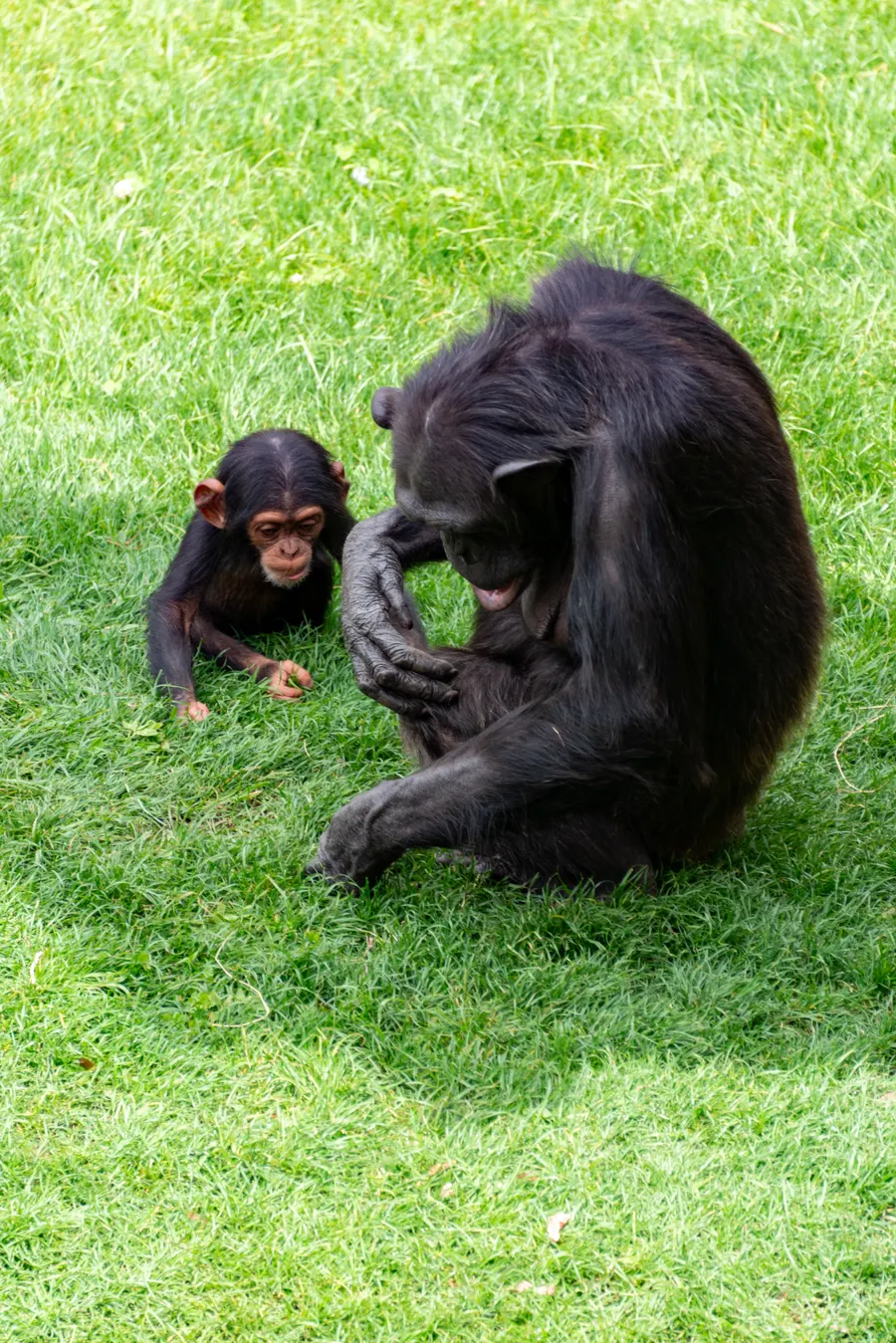
Young Chimpanzees Develop Distinct Vocal 'Accents'
A study of two chimpanzee populations found their grunts, whimpers, and laughs grow more distinct with age, challenging pure-genetics assumptions.
A regional accent that develops, not one you're born with
If you've ever noticed how a British accent and an American accent sound almost identical in a two-year-old but unmistakably different in an adult, you've observed something researchers just documented for the first time in chimpanzees. A study published September 2 in PLOS One, led by doctoral researcher Kassandra Giragosian at Queen Mary University of London alongside colleagues at the University of Portsmouth and the Institut des Sciences Cognitives Marc Jeannerod in Lyon, found that young chimpanzees develop population-specific vocal patterns that become progressively more distinct as they age, directly challenging the long-held assumption that chimpanzee calls are fixed at birth and governed purely by genetics.
Researchers have known for years that adult chimpanzees from different communities produce recognizably different versions of the same calls, a pattern scientists have compared to regional dialects. What remained genuinely unresolved was where those differences actually come from: are chimps simply born already sounding different depending on their population's genetic lineage, or does that distinctiveness build up gradually through growing up in a particular social and physical environment? This study is the first to track that question across early development rather than just comparing already-grown adults.
How you actually test a question like this
Giragosian's team compared vocalizations recorded from two geographically separated populations of eastern chimpanzees: one at Gombe National Park in Tanzania, made famous decades ago by Jane Goodall's pioneering fieldwork, and another at Chimfunshi Wildlife Orphanage in Zambia. Rather than simply comparing adults from the two sites, the researchers focused specifically on infants and juveniles, analyzing an enormous dataset of 4,733 laughs, 3,694 grunts, and 2,798 whimpers collected across 21 infants and 10 juveniles.
Using a statistical technique called permuted discriminant function analysis, essentially a method for testing whether recordings from two groups are acoustically distinguishable from each other with statistical confidence, the team found they could reliably tell the two populations apart across every call type they examined, but the ability to do so grew substantially stronger between infancy and juvenile age. As the researchers put it in their paper, "early in ontogeny, vocal behaviour is relatively similar across populations from an acoustic perspective. As ontogeny progresses, the difference between populations becomes larger."

The one exception that actually strengthens the finding
Good scientific findings are often made more convincing, not less, by an unexpected exception, and this study has one. While juvenile grunts, whimpers, and laughs all showed clear population-specific signatures, infant whimpers specifically did not display the same site-based distinction. That's a genuinely informative wrinkle rather than a flaw in the data: it suggests different call types may develop their population-specific character on different timelines, with some vocal categories picking up local dialect features earlier than others.
That kind of call-by-call variation in developmental timing is exactly the sort of detail that would be invisible in a study comparing only fully grown adults from different communities. It's also difficult to explain through a purely genetic model, since a genetically hardwired call should, in principle, show population differences from the earliest days of life, not develop them selectively for some call types before others as an individual matures.
Why this pushes back against genetic determinism
Giragosian summarized the study's core takeaway plainly: "Understanding how communication develops during early life is fundamental to understanding animal behavior. Our findings show that chimpanzee vocalizations are not simply fixed from birth but continue to develop as young animals interact with their social and ecological environments." That's a meaningful corrective to an assumption that has shaped primate communication research for years, the idea that because chimpanzee vocal repertoires are largely species-typical and don't show the kind of flexible, learned structure human language does, they must therefore be almost entirely genetically determined down to the acoustic details.
The study's authors are careful, though, not to overstate what they've found. They explicitly note their work doesn't suggest chimpanzees possess anything resembling human language, which requires shared grammar and an agreed-upon vocabulary that chimpanzee vocalizations don't exhibit. What the study does convincingly demonstrate is that the specific acoustic character of chimpanzee calls, the details that create a recognizable population "accent," isn't purely inherited. It's shaped by some combination of social learning, physical environment, and the process of growing up around vocalizing companions, even if the underlying call types themselves remain broadly consistent across the species.
A pattern that fits a broader shift in how researchers see chimpanzee behavior
This finding lands alongside a growing body of research suggesting chimpanzee behavior generally is considerably more shaped by social learning and local tradition than researchers assumed even a decade or two ago. It's a similar dynamic to the persistence of accumulative stone-throwing traditions documented at specific trees in West African chimpanzee communities, a behavior that researchers believe is culturally transmitted within specific communities rather than a universal, genetically fixed chimpanzee trait, given how narrowly it's distributed across the species as a whole. Both findings point toward the same broader conclusion: a meaningful share of what looks like fixed, "instinctive" chimpanzee behavior actually depends on which community an individual grows up in and what that community's particular traditions happen to be.
What this framework opens up for future research
Beyond the specific finding about chimpanzee accents, the study's real methodological contribution is a template other researchers can now apply elsewhere. As the authors note, "by examining vocal development through an ontogenetic lens, the study provides a valuable framework for investigating how communication systems emerge and diversify within animal populations." That's a genuinely useful research design that could extend well beyond chimpanzees, to any social species where researchers suspect population-specific communication patterns exist but haven't yet traced exactly when and how those differences actually emerge across an individual's development.
For a species whose vocal communication has often been treated as the less interesting cousin of its more visibly flexible gestural communication, this study makes a real case that chimpanzee vocalizations deserve to be studied with the same developmental lens researchers already apply to gestures, tool use, and social learning more broadly. If population-specific "accents" can develop gradually through early social experience rather than arriving fully formed at birth, that raises a genuinely open question about how much of the broader chimpanzee vocal repertoire follows the same developmental logic, one this single study, spanning two populations and three call types, has only begun to map.
Written by
Mr. Jitendra Bhatt
Msc in Chemistry and field researcher.

