 Blogerroom
Kenya Confirms First Ebola Case After Flight From Uganda
A man ill for a month crossed from Congo through Uganda and flew into Nairobi before Ebola Bundibugyo was confirmed, and 28 contacts are being traced.
A Kenyan man who had lived in Congo for seven years boarded a Jambojet flight from Uganda on Saturday, October 3, landed at Nairobi's Jomo Kenyatta International Airport shortly after 1 p.m. and was taken by relatives straight to Nairobi Hospital. Two days later he was dead. On Tuesday, Kenya's Health Cabinet Secretary Aden Duale told reporters the cause was Ebola, and that the country now has its first imported case of the Bundibugyo strain.
Three borders in a month
According to Duale's account, reported by Al Jazeera, the patient had been ill for about a month before he travelled by road from Congo to Kampala, then flew to Nairobi. The hospital isolated him on arrival and began supportive treatment, but he died at about 11:30 p.m. on Monday, October 5. He was buried on Tuesday under Ebola-safe protocols, the Health Ministry said.
Kenya is the fourth country to record a case in this outbreak, which was declared in eastern Congo in mid-May, the Associated Press reported. France reported a travel-linked case in June, per the World Health Organization as relayed by Tribune Online, and Uganda recorded 20 cases and two deaths before ending its outbreak in August. Before Tuesday there had been no active case outside Congo since that Ugandan declaration.
That timeline is the story. A sick man spent weeks moving through a region that has been on alert since May, and he reached Nairobi, a major regional air hub, before anyone had a laboratory result.
The first diagnosis was not Ebola
Duale said doctors initially treated the case as a viral fever based on the symptoms and the patient's history, and only collected samples that came back positive, according to Kenyans.co.ke's account of the briefing. Tests at Kenya's National Virology Reference Laboratory and the Kenya Medical Research Institute confirmed Bundibugyo virus, WHO said.
This is not a criticism of the clinicians. Bundibugyo's early symptoms look like many other fevers, and Science reported in May that standard field tests used in Congo often miss it because the widely deployed GeneXpert machines only recognise the Zaire species. The lesson cuts the other way: a hospital that sent samples quickly and isolated early did what the playbook asks. The risk lies in the hours before that suspicion forms.
Who has to be traced
Duale said 28 contacts had been identified, including family members and the health workers who cared for the man, per the Associated Press. The patient's flight, which carried 23 passengers according to TRT World, is also part of the contact-tracing operation. Public statements so far do not give a final contact count that includes everyone on the aircraft, so that number may change.
Contacts are watched for symptoms, and Ebola's incubation period can run up to 21 days. With exposure dates between October 3 and October 5, the follow-up window runs into the last week of October. If no one in that group falls ill by then, Kenya will have contained an imported case with a single death. If someone does, it becomes a local chain with a different set of problems.
What Kenya had already built
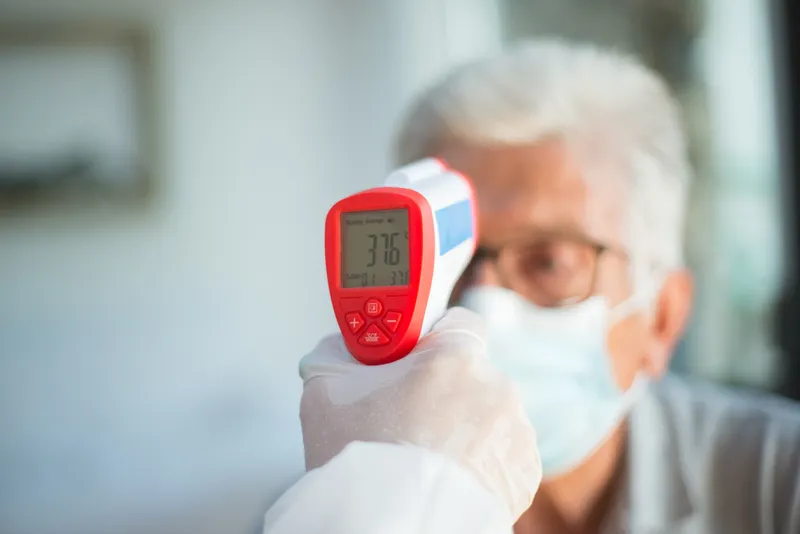
The preparation was real. WHO said Kenya had screened more than 652,000 travellers by October 6, tested 267 suspected samples and trained about 5,000 health workers, with Duale putting the trained figure at 4,971. WHO's regional director for Africa, Dr. Mohamed Janabi, said that readiness helped Kenya respond quickly.
Those numbers describe effort and volume, and the quick isolation shows they counted for something. They do not show how a man ill for a month got through the earlier stages of his journey, and accounts published so far do not say whether he was screened at the Congo border or in Kampala. That is the question public health officials in Kenya, Uganda and Congo will now be asked.
A fast-moving outbreak with few tools
The scale behind this case is large. Congo had recorded 8,603 confirmed cases and 4,148 deaths as of October 4, a fatality rate of 48.2 percent, with 59 new confirmed cases reported that day, according to figures compiled by Outbreak News Today. Sixty-four of 167 health zones across seven provinces have been affected.
There is still no licensed vaccine for the Bundibugyo species, unlike Zaire Ebola. The first participants in a Phase I trial of a candidate vaccine received it in Masaka, Uganda, on October 6, Digital Journal reported, citing the research teams. A Phase I trial tests safety and immune response, not protection, so it will not change this month's response.
For now the WHO advises against travel or trade restrictions on Congo, Uganda or Kenya, saying it will keep monitoring. That position is defensible when a single imported case is being handled well, and harder to sustain if a second one appears. The test of the next three weeks is simple: whether anyone on that list of 28 gets sick.
---
Written by
Dr. Anand Sharma
Doctor and science communicator.

